Hey ,
Lately, I've been hearing from a lot of clients who simply want to move their bodies more and find a little space to stretch. Some already have a home movement routine, but they tell me it often falls apart the minute life gets busy or stressful—sometimes, quite literally, down the toilet. It makes me wonder: why is it that starting a home practice feels tough, and keeping it going feels even tougher?
Last time, I talked a bit about gut health and promised to get into the nitty-gritty of digestion. You probably know by now that I'm a big fan of learning all the things—but honestly, if we don't actually use what we know, it's just more thoughts for our brains.
So, let's get practical! Today, I want to share one of my go-to tools for helping your digestion feel a little more relaxed and cared for (because, let's face it, our guts could use all the TLC in the world).
Over the next few weeks, in addition to providing you with lots of recent gut-health-related information, I will help you establish a foundation for a stress-busting, gut-nourishing yoga practice at home. We'll go slow, at the pace of the nervous system, so your body and schedule have enough time to adjust to the changes.
Welcome To The Belly Breathing Practice:
Many of us hold tension in the muscles of our abdomen: some to appear slimmer, others as a way of muscle armour, to guard ourselves from a too fast, too loud, too busy world. Layer shallow, rapid chest
breathing on top of tension, and you've got a perfect recipe for digestive blues.
When we breathe deeply into the belly rather than shallowly into the chest, the diaphragm softly massages and relaxes our internal organs, helping food move more smoothly through the digestive
tract and ease away common discomforts like bloating and sluggishness.
Don't underestimate the effectiveness of this technique. Just the other day, it helped one of my clients shift from a gut-wrenching belly upset to happy,
relaxed digestive gurgles, all in under 20 minutes.
How-tos:
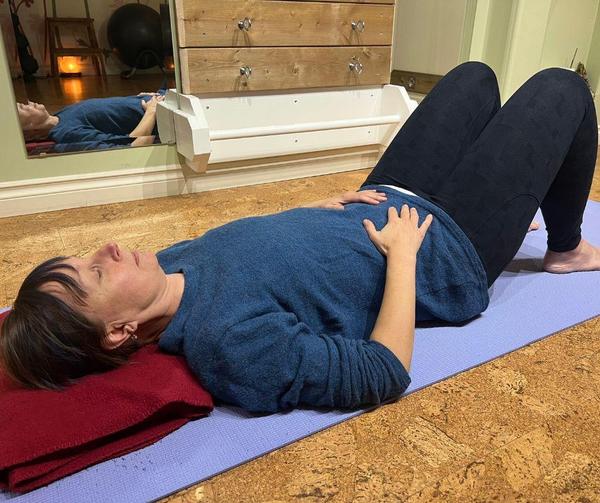
This breathing practice is traditionally done while lying on your back with your knees bent; however, if you plan to practice for longer than 2-3 minutes, I highly recommend supporting your knees. Use anything you have on hand to help your knees stay
in a comfortably bent position.
Alternatively, experiment with this breath while lying on your side. Is it easier to belly breathe when you are lying on your right or your left side?
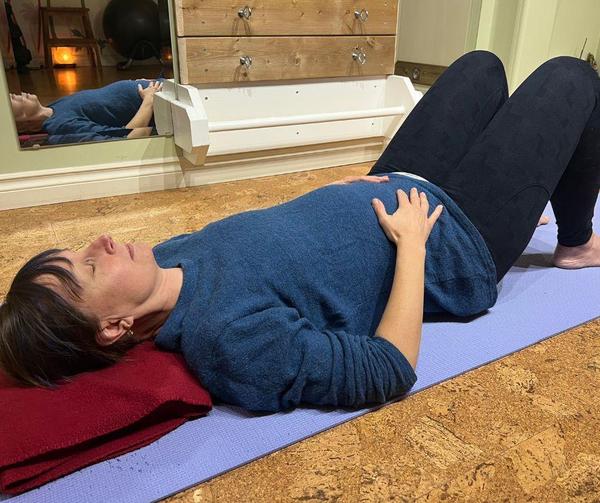
- Fold your hands over your belly. If this position doesn't work for you, consider a more comfortable shape, such as with your arms down by your sides or out to the sides. The most important thing here is comfort: if you aren't comfortable, you will tense up, and if you are tensing, it's hard to find a relaxed breath.
- You may want to close your eyes to turn your attention inward. Notice if there's any lingering tension in the body, and adjust your props if needed.
- Gently inhale your breath into your belly - the sensation of your hand on your belly will help to guide
your breath. Feel your belly rising and expanding as you inhale, and falling as you exhale. Imagine inhaling deeply into the bottom of your lungs.
- As you continue this breathing practice, you may notice your body gradually settling into a more relaxed state. If, instead, you are feeling more agitated than
when you started, it's time to adjust.
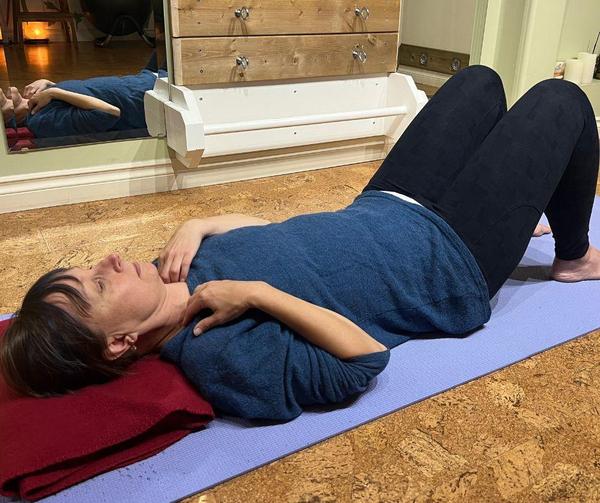
- Gently touch your fingers to the bottom of your neck - right at where the neck meets the chest and front shoulder. Do you notice any tension here? Are these muscles working hard to help you breathe? If so, you are working way too hard! Relax your effort a bit. Look for
"effortless effort," a sense that you are guiding your breath, but just barely.
- Depending on your regular breathing style, you might feel deeply relaxed or deeply aggravated - even to the point of hyperventilation - by this breathing practice. Both of these, as well anything in between, are normal responses
to a new breathing practice. If you are feeling deeply relaxed, stay for as long as your comfortable (without falling asleep!) If you are feeling activated, start with a shorter - 30 seconds to 1 minute - practice, and work your way up from there.
The minimum
recommended time for a breathing practice is 4 minutes. Still, I always think it's better to do something than nothing. Try it for even a minute while sitting in your comfortable chair. How does that feel?