Hey ,
October is Menopause Awareness Month. Could there be a better time to discuss the changes that come with this transition?
As we focus on digestion this fall, let's take a look at how menopause can stir up our gut workings. I hope you find this information useful and
maybe even feel inspired to get on your mat!
Midlife women know that peri- and menopause are more than just hot flashes. Most of us experience mood swings, joint aches, sleep problems, and a general feeling of being 'off'. Hormonal
changes can also make a mess out of our digestive system.
As estrogen and progesterone levels decline, the balance of friendly bacteria in the gut shifts, often resulting in digestive symptoms such as bloating, irregularity, and even the development of new food
sensitivities.
This intricate relationship between the gut and hormones is a two-way street. A diverse gut microbiome can help maintain hormone balance, alleviate inflammation, and improve mood. On the other hand, poor digestion and sluggish elimination can intensify
menopause symptoms like fatigue, hot flashes, and sleep disturbances.
A 2023 study found that women experiencing constipation reported more severe menopausal symptoms in both physical and psychological domains. Less frequent bowel movements were also linked to worsened hot
flashes and physical discomfort. Of course, you and I know that menopause can turn our elimination into a very slow-go.
Let's do something about that slow-go!
Here is the next instalment for the home practice:
As I mentioned last time, many of us unknowingly hold tension in the muscles of our abdomen.
When life gets stressful or overwhelming,
it's common for the muscles in the entire abdomen to tense up. This tightness isn't about posture or physical strength—it's our body's own way of dealing with difficult situations, guarding the vulnerable gut area where emotions are deeply felt.
This "sucking stomach in" -
whether due to stress or otherwise - displaces the digestive organs and makes digestion and elimination more difficult for our body.
Today, we will use the now-familiar Belly Breathing practice to help us recognize and relax out of this habitual tension.
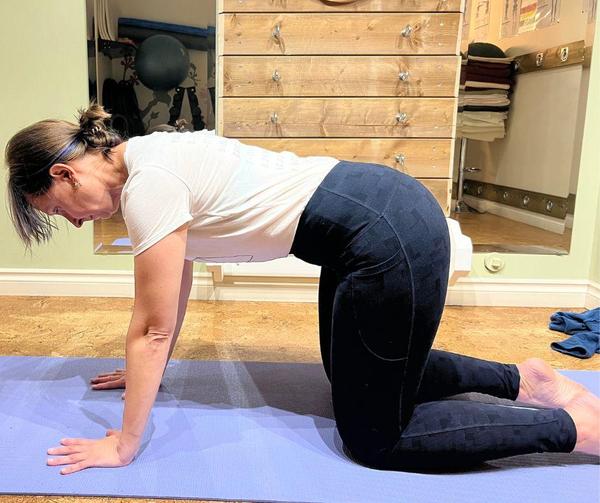
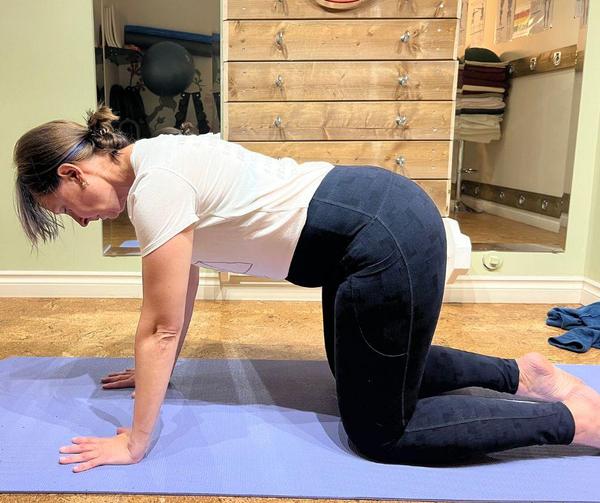
While I demonstrate it here on my hands and knees, feel free to choose a position that feels easily accessible for you: you can use a chair or even a counter for support. The important thing here is that your spine is somewhat parallel to the floor (I say "somewhat" because our spines,
unlike the floors, have curves). Even lying on your belly works!
How-tos:
- Begin on your back with a Belly Breathing practice, and take 5 to 10 breaths. Notice how much your abdomen expands as you breathe in, and how easy (or hard) it is to get it to expand.
- Now come onto your hands and knees, or into any forward-bending position that works well for you.
- As you inhale, can you relax your abdomen?
This might sound easy, but when you consider that your abdominal wall runs from the pubic bone and all the way up to the bottom of the breast bone, you might recognize
that you are only able to relax a small portion of your abdomen.
Just a note here: you probably not going to enjoy the reality of letting all of your belly go, at least at first. If you have a few extra pounds that you've been sucking up, letting all that mass out of your trunk, might make you feel uneasy and vulnerable.
- Focus your attention specifically on the muscles just below the front bottom ribs: can you relax here, too?
- Is there tension around your jaw that you can let go of?
Does softening the jaw also relax your belly?
- Stay for up to 5 breaths; take a break, then repeat.
- Now return to your back for the Belly Breathing check-in: once again, take 5 -10 Belly Breaths here. Are there any changes?
This simple exercise is a fantastic way to help your elimination along. It is also great awareness primer for a core wake-up drill I will share with you next time.