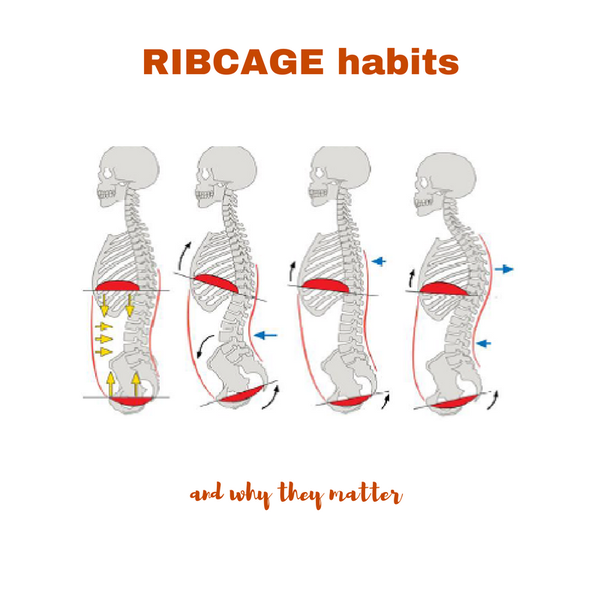
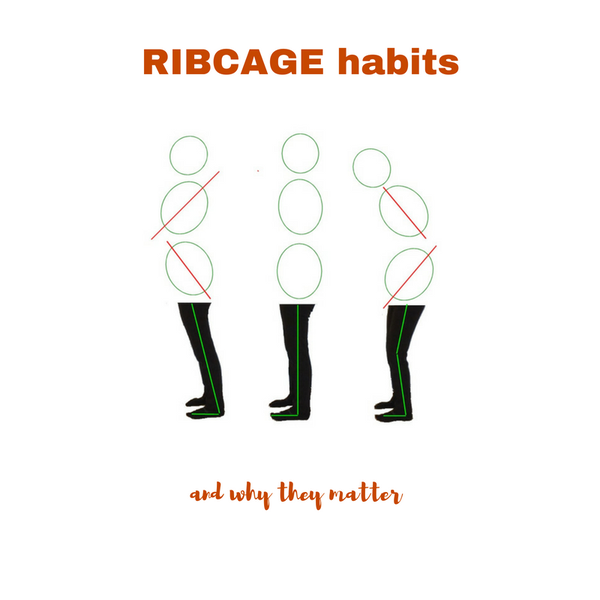
In a neutral alignment the rib cage sits directly atop of the upper part of pelvis.
One of the most common postural compensation is ribcage misplacement - ribcage that is shifted ahead or behind of the pelvis, or
skewed / twisted to one side or another.
Here is what happens on the inside when the ribcage moves out of alignment:
Pelvis to ribcage alignment is crucial, because when these two do not match up, the spinal bones between them become stressed and improperly loaded.
The imbalanced ribcage and spinal vertebrae then shift the line of pull on the
respiratory diaphragm.
The diaphragm is your primary breathing muscle. When it becomes loaded with trigger points, weakness or stiffness, a host of physiological dysfunctions can develop.
The diaphragm is directly linked to the stress response and the emotional centers of the brain. Improper breathing accelerates sympathetic (activation) overload, anxiety, and out of control
feelings in the nervous system. This is of particular importance to those of you who live with chronic pain.
The diaphragm is also in direct contact the connective tissues of the heart and its main blood vessels, the aorta and vena cava. Distortions of the diaphragm can put pressure on the heart and aorta, impacting their function and blood flow over time.
The diaphragm also acts as a
soft-tissue partition between the chest and abdominal cavity - all the tubes that bring blood supply to the lower body as well as esophagus have to go through the diaphragm. Slumpy alignment can weaken the esophageal junction and create gapping of the sphincter within esophagus - leading to backflow of food, also known as acid reflux and heartburn.
The respiratory diaphragm up-and-down movement helps with peristalsis and smooth
elimination, as well as keeps the health of the pelvic floor. When this up-down movement is becomes disrupted and asymmetrical, the disturbances in elimination and pelvic floor tone are inevitable.
People who experience any or all of these issues tend to not attribute them to bad posture. Aches and pains are easier to track to posture, but poor posture creates a host of total body
dysfunction.
On the movement side of things:
You cannot move efficiently through your hip and shoulder girdle, unless you are able to use the big muscles of your hips and shoulders (gluts, hams, quads, biceps, triceps) to drive your movement.
Compromised ribcage alignment leads to compromised function through hips and shoulders. It is quite
likely that you’ll drive your hip and shoulder movement from your back. And if you stand with your bottom ribs jutting forward, you will, in all likelihood take this pattern to your back bend, and overuse and kink your mid to low back to get into the backbend.
On a personal note: I went to a public yoga class a couple of weeks ago, and the most common compensation pattern there was the overwhelming overuse / abuse of mid-back muscles
whenever the arms went overhead or hips became extended - as in a lunge pose.
This is just one – JUST ONE! – of the many compensation patterns. Scary, hey?
Check your ribcage alignment here: