Weekly class follow-ups that explain the how's and
the why's behind the practice – along with a good post-class sleep – are truly a Satori trademark. I do sincerely hope you get a chance to experience that!
Many of you have asked how to join a regular Satori class.
Here's the deal:
We have
created a special welcome discount for those of you wishing to register for our winter class session. Please use a discount code WARMWELCOME10 to save 10$ off any
winter registration - it is valid till the end of Thursday, November 24. I have also included registration links at the bottom of this e-mail for your convenience.
For those of you wanting
to start right away - I have a limited availability in some of the current classes (Pain Care and Pain Care + classes are on Tuesdays at 7:45 PM or Saturdays at 10:15 AM).
Here is what we did in class and why:
Body Mapping
Fascia, your body's
connective tissue network, serves as peripheral nervous system super highway.
There are six times as many sensory neurons loaded in fascial network as in any other tissue of the body, except for your skin. Much of what you feel physically is relayed by the well functioning nerve endings laced through the scaffolding of the fascia.
The nerves, like any other tissue, depend on proper motion, nutrition, and balanced fluid environment in order to
signal correctly.
When pain persists, both peripheral and central nervous system undergo significant change.
Pain spells less movement. Less movement leads to limitation and dehydration of fascia, which, in turn, leads to compression and dehydration of peripheral nerve endings - so they are not able to communicate sensations correctly or clearly.
Peripheral nerve endings also undergo another significant change:
nerves that once sensed motion, position, temperature or touch lose their capacity to do so. Instead, they become nociceptors, which are signalers of pain. This is why many of chronic pain folk become super sensitive to cold, touch, and even clothing tags.
Another side of this change is that your brain can no longer sense the location of your body parts in space - your nervous system is so busy sensing pain, that it no longer has the capacity for proprioception (body
sense). The more pain you have, the less coordinated and more prone to injury you are. Converse is also true: the more body aware you are, the more you are able to turn your pain down - it is like flipping the sensory nerve communication switch, so that pain sensors cannot dominate your brain any longer.
This is part of the reason why we spent a lot of class time on body mapping (the other piece of it is that body mapping rewires the brain itself - if I get going on this
topic, the e-mail might be 20 pages long!).
I have attached a 10-point relaxation practice - something that we use in regular classes to improve proprioception and body sense.
Breath Work
Persistent pain changes the way we
breathe.
We hold our breath when we move or getting ready to move. More often than not, we hold our exhale.
With time, this pattern of holding or uneven breathing becomes ingrained - we simply no longer aware of how we breathe.
Unfortunately breath holding and uneven breath patterns signal our brain and nervous system that our physical body is in distress. Nervous system responds by flipping the adrenaline switch and sending our
body into fight / flight mode - all because of uneven, shallow breathing. Fight / flight mode creates more shallow breathing, and also changes our biochemistry, making the peripheral system nerve endings (read above) so much more sensitive. In other words - poor breathing habits perpetuate pain.
In class, our main focus was on developing healthier breathing patterns, as well as establishing breath-movement connection. Here is why this is important:
~ Healthy breathing creates vital structural support for your back (especially lumbar spine) as well as your shoulders.
~ it relaxes tight neck muscles, can prevent reoccurring headaches and migraines, as well as assist a better thyroid function
~it releases mid-back tension
~ it massages (no joke!) your heart, lungs, as well as your digestive organs, assisting better digestion and
elimination
~ healthy breathing patterns are absolutely necessary in the prevention + treatment of pelvic floor disorders
~ healthy breathing is also required for a healthy function of the nervous system (including your brain), appropriate blood oxygen saturation, and reduced pain perception.
Here is a link to the
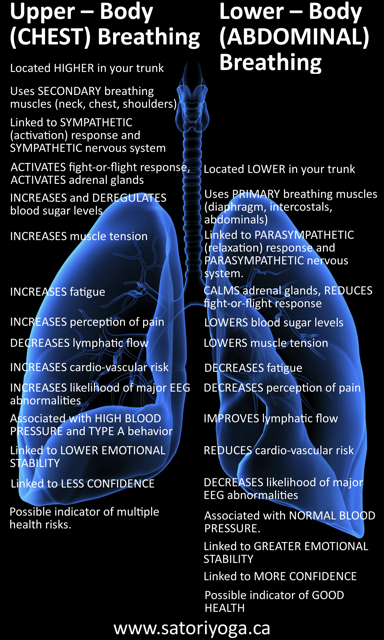
guideline for a fundamental practice that we've used in yesterday's class, and below is an image that compares upper/ chest and lower/diaphragmatic body breathing.