Welcome to this week's Sunday round up.
A few house-keeping items to begin with:
~ some of you have asked me to resend the registration links - they are included below.
~ some of you asked for description for the Core RE-store class. Here it
is:
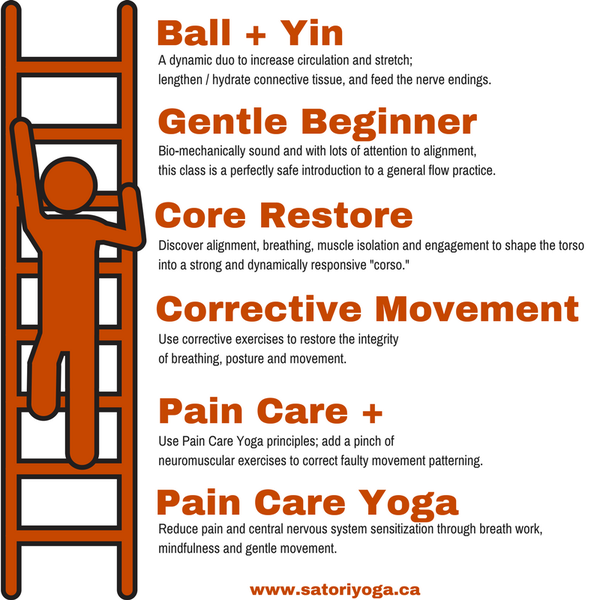
Core RE-store class is the bridge between corrective movement and a flow yoga class. We focus our attention on all things torso - alignment, breathing, muscle isolation and engagement - to shape our trunk into a strong and dynamically responsive "corso."
It's not all crunches and planks, either.
What sets this class apart is attention to lengthening as well as strengthening the vital muscles of the core, so that you can stabilize the bones in the upper body, rotate the torso with proper spinal curvature, and maintain stable pelvic position while sitting, standing, walking and
exercising.
Now over to the follow up:
In this weeks Pain Care class we talked about the central sensitization of the nervous system that comes with
persistent pain.
Basically what happens is this: persistent pain throws the whole nervous system off whack (including even changing the way that the brain itself works), which leads to more pain, and creates a vicious circle of more pain, more sensitization, and more changes to the brain. Hard loop to get out of.
Pain Care Yoga gives us the tools (breathing, mindfulness, mindful movement) to help reduce nervous system sensitization.
I've put together a PDF guide that can
hopefully help you understand the nature of persistent pain, and also to challenge very common, yet erroneous beliefs about chronic pain.
In class we also used MIRROR technique of dealing with persistent pain.
The basic protocol is this:
~read the PDF guide to understand the role the brain plays in chronic pain ~picture the part of the brain that is responsible for creating pain
in your particular situation (this needs not to be specific - just picture brain activation however you can!)
~every time (this is very important - EVERY TIME!) you experience pain, visualize turning this activation down by any method that works best for you: dimming it, painting over it, wiping it off.
I know this
probably sounds like I completely lost my marbles.
And maybe I have. I don't know for sure.
This protocol, however, comes from one of the most successful chronic pain management clinics in North America: their motto is "don't manage; heal intractable pain." I kinda trust their track
record.
Movement Yoga:
We've done a few unusual moves - such as chair lunges - and I am curious how your body liked that?
The standing posture experiment goes like this ( you really don't need another
person pressing on your shoulders once you've tuned into bodily sensations):
~ begin in your regular standing posture. Feel the sensations.
~ now find pelvic tilt and the largest movement currently available in the pelvic tilt; gradually reduce range of motion of the pelvic tilt until it feels to you that you have arrived to YOUR center. And there you have it!
~ of course it is much easier to do it with another -
so that you get instant feedback and are reassured that you have, indeed, found your center. The truth of the matter is, though, that we are learning to listen to our internal sensations and find that balanced spot - eventually without swinging the pelvis - all on our very own.
Here is your invitation for
SPRING YOGA registration - classes started to fill (especially that new core class), so please be sure to register early. Remember to use coupon code SPRINGINTOYOGA15 before March 8th to get your discounted registration.
I have also included Satori class map at the bottom of the e-mail.