Past Thursday, as students in the Corrective Movement class were finishing some ball - ing, Jan winked at me, and said, “Some pretty sneaky core work you are having us do here.”
I winked right back.
The truth is, I’ve been sneaking in the core work in almost all of the classes, and it is totally NOT what you think.
Spoiler alert!
This exercise will not only improve the shape of your waist and stability of your back.
Practiced regularly, it will up your golf game and reduce your blood pressure, so please read on.
Many of us are quite determined to get our stomachs in shape.
Over the 12 years of
teaching, I’ve seen people crunch, flex, burpee, bulge and suck in to get the looks of the flatter abs. Most of that effort vanished in vain without delivering…
Today, I’d like to talk to you about why all the crunches, flexes, burpees and “10 Minutes To Flatter Abs” DVD’s don’t deliver, and what actually can.
Let’s start with some fun alignment facts (I won’t get carried away, I
promise!)
Fun fact #1:
The natural tone of the abdominals will kick in when the pelvis and ribcage are in the right position. Yes, yes, I know – I’ve said this bazillion times already!
Even more fun (or not?) is the fact that doing crunches with incorrect position of
ribcage or pelvis can lead to shortening of the abdominal muscles, sore back, and if those two are not motivation enough, also to a wider middle.
Whaaaat???
Totally not what you had in mind when you started that crunchee – burpee program, I know.
Fun fact #2:
The strength of the abdomen will always match the strength of your back. If your idea of a “good posture” includes pulling the shoulders back and a slight arch the lower part of your mid back – whether sitting or standing - you are creating a tight and weak back along with over-stretched and also weak abdominals.
We can also call this posture “a back spasm in the making.”
Fun fact #3:
We most often think about “washboard abs,” while considering the core / ab training program. Washboards are formed by rectus abdominus muscles: these run up and down vertically and form a part of body’s external corset – which, sadly, has no relationship to creating a waist or stabilizing the spine.
On
the other hand, obliques and transverse abdominal muscles, spanning left to right and also on diagonals, are the ones to give you a waist. They also form a part of the internal core corset, stabilize the spine, and provide a dynamic, functional stability.
Try this experiment:
Contract your abs as if you are doing a crunch.
Now breathe fully.
Can you do both?
The question, of course, is this: what kind of stability is it, if you have to choose between breathing well and stabilizing?
So what is that sneaky abdominal exercise I’ve been sliding under the
radar?
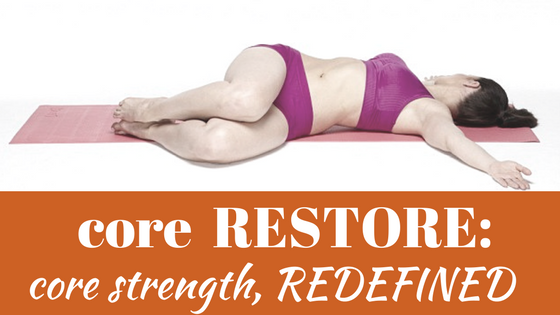
A simple SPINAL TWIST.
Of course, each class had it’s own variation of the spinal twist – from the easiest Knees-Bent reclined twist in Pain Care Classes, to Twisted Roots variation in a Beginner class, amd a Fully Extended twist with some pretty challenging alignment notes in a Yin class. The objective, however, stayed the same: lengthening the abdominals that crisscross our internal
corset.
Try this on your own:
- Lie on your back and bring your right knee to the chest.
- As you exhale, cross the right knee to the left; here, you can place your left hand over the right knee.
- Allow your pelvis to rotate to the left so that you can take the right knee toward the ground on the left side
of your body.
- Let the rest of you – the ribcage, and especially your right shoulder blade, remain on the ground.
- Don’t force things: if your waist is very tight you won’t twist so much as roll to get the knee to the floor. You can tell that your rolled if your spine and shoulders all rotated over with your hips.
- Ideally, your spine, shoulders and chest all stay planted on the ground, and your waist muscles are LONG ENOUGH to allow your pelvis to
move.
Are you a roller?
Do this exercise every day until you start to twist to decrease your waist size and increase the strength of stomach and back musculature.
Extra bonus! This is a great exercise to improve your golf game.
Extra EXTRA bonus! Next week we’ll talk about how this exercise can also help you to lower the blood pressure. Yup, many birds, one stone – that’s what I call effective exercise!
FYI, the next CORE RESTORE 5-week set is starting on May
27th.
This program delivers a triple punch:
~ a little bit of theory so you can understand why and what we are doing
~ a
boat load of class work to build awareness and strength in the inner corset
~ some homework (you decide what’s appropriate amount), and weekly on and off the mat challenges to keep building awareness and strength between classes.
Join us on the mat
and learn the simple and effective techniques to help you up your game - whatever your game happens to be.
See you on the mat,