Scientists used to think that there's just one pain center in the
brain.
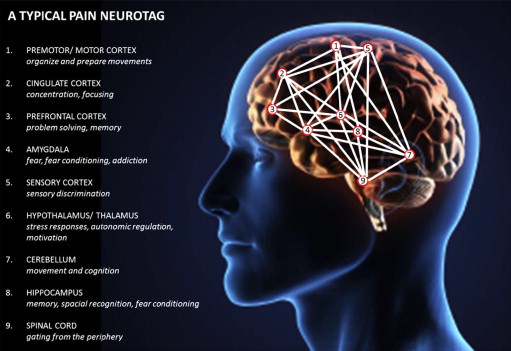
Now, with the help of functional imaging we've learned that there are many areas of the brain that are involved in pain processing. One of the most important things scientists have discovered is that in a pain experience, hundreds of brain parts are involved are involved simultaneously.
In fact, pain can use many different parts of the brain to express itself. In other words, in order for incoming body sensation to be expressed and
experienced as pain (VS pressure, cold, heat, etc), different parts of the brain have to link together chemically and electrically to light up the brain in a very specific (and unique to you) way.
The oversensitive areas in the brain that can be used by the pain are:
~ premotor / motor complex - organize and prepare for movements
~ cingulate cortex - concentration and focusing
~ prefrontal cortex - problem solving,
memory
~ amygdala - fear, fear conditioning, addiction
~ sensory complex - sensory descrimination
~ hypothalamus / thalamus - stress response, self-regulation, motivation
~ cerebellum - movement and cognition
~ hippocampus - memory, spatial cognition, fear conditioning
As you can see, pain can hijack the clusters of nodes in the brain that are used for sensation, movement, emotions and memory - which can explain mood
fluctuations, memory issues, and a whole lot of other things.
For example, chronic pain interferes with our ability to solidify our experience into memory - the transition from short term to long term memory is inhibited.
When pain persists, some of the brain nodes become very sensitive and begin to react with the slightest trigger. The particular pattern of brain activity which creates the perception of pain is called a "neurotag" for
pain.
On - The - Mat Pain Care challenge:
Here are two ways of challenging the existing pain
neurotag:
1. Imagined movements - don't move the actual body:
Imagined movements activate many of the same brain areas as actual movements. If you think about the movement you know to be painful, or watch someone else perform that movement, movement neurotag (a particular pattern of brain activation to create movement) will be activated but the pain neurotag most likely not.
If your pain is very chronic and
severe, even imagined movements can be painful. If that's the case for you, imagine parts of the movements.
What you are doing here is helping your brain orchestra to play a gentle movement tune without playing its accompanying pain tune.
2. Change your relationship to gravity - we do a lot of this in a yoga class:
Sitting on the floor with your legs straight out in front of you is the same
body formation as lying on the floor, face up, with your legs up in the air, OR standing bent over at the waist. So why do some of these movements feel easier than others? The answer is - you've changed your relationship to gravity!
Changing gravitational influences allow you to run brain representations of the movement in similar but slightly different and novel way - and it challenges the pain neurotag!
Off - The - Mat Pain Care challenge:
Performing movements in water is a great way to change your relationship to gravity and challenge pain neurotag.
What else can you do to create a different and novel input for your brain, while at
the same time challenging the pain neurotag?