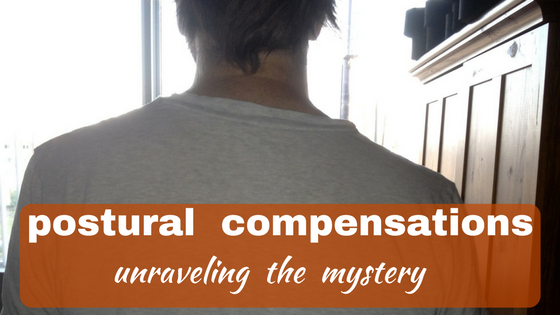
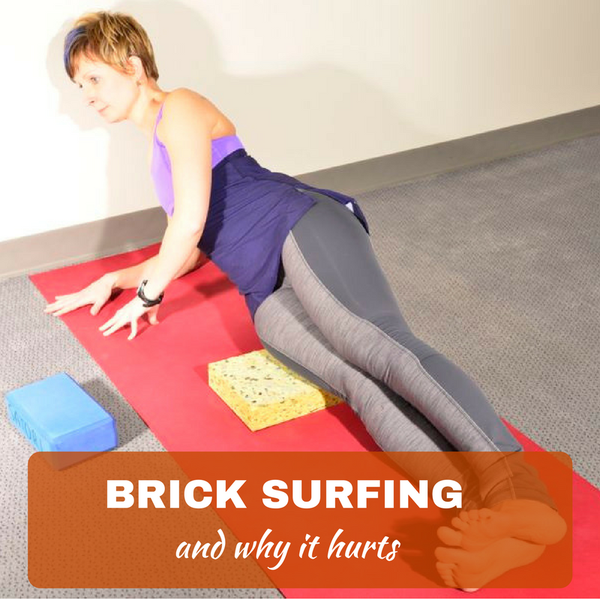
One of the Core Restore Yoga class off – the – mat challenges was to simply observe people
move.
Along with double-step and side-step stair climbing, this observational challenge has proven to be one of the more popular off-the-mat inquires. No one liked the brick surfing for IT band challenge… I wonder why?
Postural compensations are not that hard to pick out – once you know what to look for.
Even an untrained eye can recognize an imbalance in posture or gait;
a trained professional can see an old ankle injury in the way you climb the stairs, or a “locked up” low back in your walk.
So how do these compensation patterns come about, and more importantly – why do they linger once the old injury has healed itself?
Has it healed itself?
Not to play the devil’s advocate or anything, but this is a good check stop to examine your
beliefs about injury healing and body resiliency.
Take back pain for example:
Back pain usually brings on changes in trunk muscle activity – the brain “primes” the big long muscles for protection. Scientists now believe that these changes, most likely,
help the brain to splint the trunk, so you have more sense of stability.
However, muscle activity doesn’t always return to normal even if the pain eventually resolves.
In the long term, continued over activation of big long muscles – whether it is in the back, or anywhere else in the body – is not smart. As a general rule, when big long muscles (think big muscles along the spine, around the shoulder or the hip – such
as trapezius, hamstrings, gluts or IT band) stay active for a long time they tend to contract, there’s a build up of acid, and they start to feel stiff.
Our body is quite economical in the way it works.
If the big long muscles are consistently turned on, the shorter muscles – like the little ones that stabilize the vertebrae or the pelvis, for example – go to sleep, because there’s no need for them to
work.
These changes prime you for developing compensation patterns:
Get this: fear or anticipation of pain MAY BE ENOUGH to prevent changes returning to normal – it seems that our beliefs about the body have an affect on all our systems, including the
pre-motor and motor cortex.
In the long run, these erroneous changes can make you move differently, hold yourself differently, and even behave and talk differently – all of which have long-term consequences on both physical and mental state. This is why old injuries are more likely to revisit and also are easier to identify at times of stress.
Repeat this pattern a few times over, and your belief in resiliency
of your body is strained at best, and shattered at its worst. The vicious circle of chronic strain, pain, and injury has been set.
Once the new motor patterns have been learned, they can be very hard to reverse. Therein lies the trap of common exercise programs: unless you’ve taken the time to build awareness and understand your compensation patterns, you will continue to perform your “prescribed exercises” using all of the faulty mechanical and
belief patterns you’ve accumulated in your life so far.
It is a small wonder then that IT band brick surfing felt so yucky for everyone in the Core Restore class…