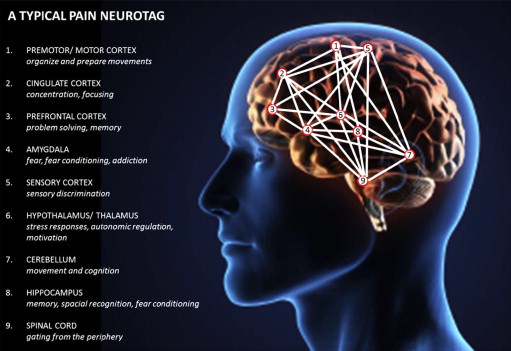
Scientists used to think that there's just one pain center in the brain.
Now, with the help of functional imaging they've learned that there are many areas of the brain that are involved in pain processing. One of the most important things scientists have discovered is that in a pain experience, hundreds of brain parts are
involved are involved simultaneously.
In fact, pain can use many different parts of the brain to express itself. In other words, in order for incoming body sensation to be expressed and experienced as pain (VS pressure, cold, heat, etc), different parts of the brain have to link together chemically and electrically to light up the brain in a very specific (and unique to you) way.
The oversensitive areas in the brain that can be used by the
pain are:
~ premotor / motor complex - organize and prepare for movements
~ cingulate cortex - concentration and focusing
~ prefrontal cortex - problem solving, memory
~ amygdala - fear, fear conditioning, addiction
~ sensory complex - sensory discrimination
~ hypothalamus / thalamus - stress response, self-regulation, motivation
~ cerebellum - movement and cognition
~ hippocampus -
memory, spatial cognition, fear conditioning
As you can see, pain can hijack the clusters of nodes in the brain that are used for sensation, movement, stability, emotions and memory - which can explain mood fluctuations, memory issues, and also trouble with balance.
For example, chronic pain interferes with our ability to solidify our experience into memory - the transition from short term to long term
memory is inhibited.
When pain persists, some of the brain nodes become very sensitive and begin to react with the slightest trigger. The particular pattern of brain activity which creates the perception of pain is called a "neurotag" for pain.
Pain neurotag is challenged whenever we imagine the movements (see sidebar), or change our relationship to
gravity.
What else can you do to create a different and novel input for your brain, while at the same time challenging the pain neurotag?
Hint: think breath! Whenever you gasp or hold your breath to perform certain movements, you reinforce the old neurotag!