Welcome to our last class follow up for this session.
Before I get all excited and tangled up in today's topic, I want to
remind you that the next yoga session starts the week of January 8th - and all registrations for this session
live here.
You can still SAVE 10$ off your
registration by filling out
this survey (be sure to fill it out prior to registering to get the discount code).
Satori Loyalty program is yours for the taking as well - we will give you 10$ back for every
person you refer to classes once they register.
Now off to the exciting stuff!
Last week some of
Core Restore students were caught off guard by how different the range of motion was in the left and right hip. Of course, naturally, the question arose:
how in the heck did I get to be like this? {this
question is just as applicable to any other chronic situation as it is to chronic postural imbalances}.
In class, lacking time, I just said, "think how differently you use the two sides of the body."
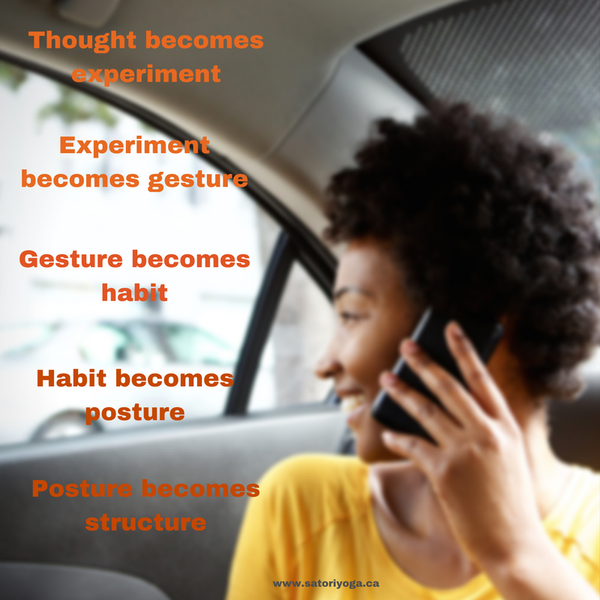
Reviewing my post-class notes, I suddenly remembered how well this concept was explained during one of my Anatomy Trains training, and so I created a graphic (up
at the very top!) to help Core Restore students understand the process.
You become {almost like the Velveteen Rabbit}:
Thought becomes an experiment
Experiment becomes a gesture
Gesture becomes a habit (if
experiment is successful)
Habit becomes a posture
Posture becomes a structure.
This process is etched all the deeper into our memory if it is wrapped up in emotion {do you wince every time you move your shoulder in a certain way?}
Looking at the graphic and the process, it is easy to
understand that in order to reverse some of the chronic imbalances and discrepancies, we need to use various approaches and sometimes go to the very roots of our imbalances - all the way back to experimentation stage.
This is our topic of the day ( I totally get excited even thinking about the possibilities here!)
Here are 7 principles of body balance:
Relaxation
Pure movement - both bilateral and unitlateral
Resiliency
Stability
Mobility
Strength
Flexibility
These principles don't follow a linear path - that is, they don't begin with one, then the next, which leads to the next. Our path here is "linear - circular," with each principle feeding off the rest.
For example, folk who are injured, ill, or fatigued - whether it
is acute or chronic - need to be able to relax, to let go - and that, often, is the most challenging thing. Yet, without this relaxation, we will never be able to fully feel the ease in movement or posture, no matter how modified it is. Nor we will be able to experience pure movement.
We may want to develop an inner strength or resiliency, but if we don't know how to "let go," there will always be an
element of stiffness in the movement... and often strain in our lives...
Let's take a closer look ( I know its pre-Xmas crunch, I will be short, I promise!) at each principle, while remembering that all of them must come together to form a really tasty stew.
Relaxation: we cultivate an
ability to stay alert while relaxing, and Savasana is our training ground. Are you falling asleep during Savasana? Do you get restless? All of these are indications that your nervous system is unfamiliar with the state of relaxed awareness.
Pure Movement: an ability to sense and create a movement in the joint at play, and also feel when the movement pattern becomes a
compensatory one. Speaking in Core Restore language, for example, we look for hip flexion or extension VS pelvic tilting or rib cage shifting.
Resiliency: an ability to connect the state of relaxed awareness with pure movement. Resiliency takes the calm and relaxed feeling we experience in Savasana, and carries it into the postural practice.
Stability: an ability to utilize muscles' capacity to provide support, to keep a joint firmly in position, or to hold one structure of the body steady while moving another structure.
Mobility: this is joint's ability to move freely. When the body becomes injured,
fatigued, or ill, the muscles that cross the joints and connective tissue around the joints become tight, reducing the freedom of joint movement. As a result, the key joint that is not moving loses its range of motion ( becomes hypo-mobile), while the joints around it that are compensating, become hyper-mobile. Now compare your ability to move well through the hip joint and the knee joint....
Strength: is the ability of a muscle to generate force. Tight muscle is always a weak muscle. The greatest strength comes from a body that is relaxed and aligned, that has proper joint mobility and stability from the core outward.
Flexibility: where mobility is the freedom of movement, flexibility is the range of movement of a joint.
While most modern yoga classes focus squarely on developing flexibility, we must be careful to balance those gains of flexibility with gains in strength and stability.
To finish - on the subject, and our session, try the Breathe - Feel - Soften - Strengthen approach:
Breathe: close your eyes and become aware of the breath. Notice how your breath moves and feels. The trick here is to not change what you notice, but rather become acutely aware of what is already there.
Feel: notice how you feel - physically, emotionally, mentally, soulfully. Where do you feel at ease? Where do you feel your breath? How was your day with you? How were you with your day?
Soften: allow yourself to relax, to settle. This could be challenging for those of us with any "type - A - ness" in our constitution. Going slower might feel like
doing nothing, and the temptation to speed up will be right there waiting for you. Still soften... trust the process.
Strengthen: strengthen this place of ease by recognizing that softening is necessary for finding ease. It enable tight muscles to release, which provides a greater foundation for building strength. Allow yourself to "let go" - you'll get much further
much faster.
Enjoy your Christmas break. Remember to breathe. See you in the New Year!