Many Satori students have mentioned that their
weekly yoga class is the only chance they get to slow down and relax.
Is that true for you, too?
This is why this week I wanted to address stress and how it changes our movement strategies.
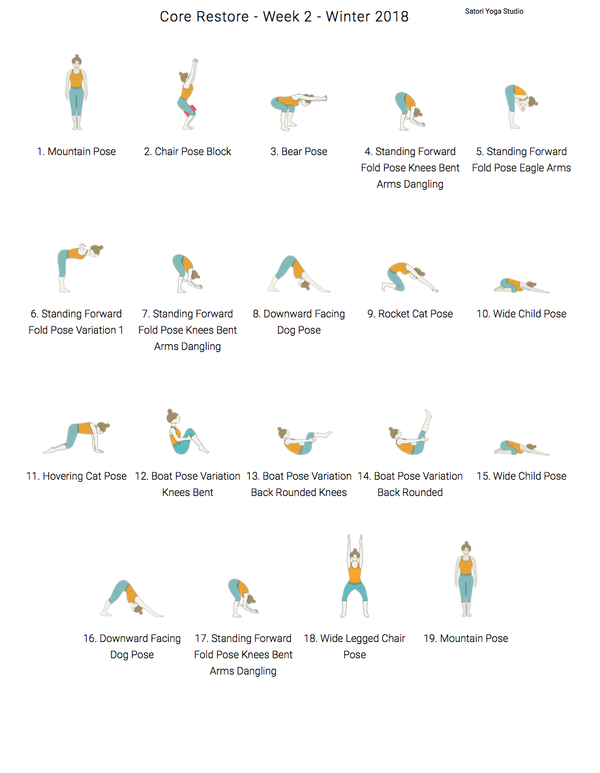
I have also included the in-class sequence that we are just starting to build - practice it once or twice before the next class (it will only take 5-7 minutes) to get the hang of new moves and also feel into the body.
Stress And Muscle Recruitment:
Whenever there's stress (and, of course, fight or flight response), brain "primes"
certain muscles to help you escape.
This is great in the short term - you get ready to run away or fight by "priming" big long muscles such as hamstrings or trapezius. These big muscles are best suited to do this job because they can produce a great deal of torque, partly because they cross more than one joint and partly because they can shorten a great deal.
In the long term, continued over activation of big long muscles – whether it is in the back, or anywhere else in the body – is not
smart.
As a general rule, when big long muscles (think big muscles along the spine, around the shoulder or the hip – such as trapezius, hamstrings, gluts or IT band) stay active for a long time they tend to contract, there’s a build up of acid, and they start to feel stiff.
Our body is quite economical in the way it works.
If the big
long muscles are consistently turned on, the shorter muscles – like the little ones that stabilize the vertebrae or the pelvis, for example – go to sleep, because there’s no need for them to work.
These changes prime you for developing compensation patterns.
In the long run, these erroneous changes can make you move differently, hold yourself differently, and even behave and talk differently – all of which have long-term consequences on both physical and
mental state. This is why old injuries are more likely to revisit and also are easier to identify at times of stress.
Stretching feels awesome!
It is a great idea to stretch the tight muscles and strengthen the weaker ones ( like we have been doing for this past few weeks).
More importantly, though, is to identify + upgrade your stress management strategies so that you can downregulate your nervous system efficiently and help
those big long {and very tired} muscles to find ease and peace.
Core Restore - Foundation Sequence:
Treat the sequence as an exploration tool to get to know your body - which movements / postures feel organic? easy? available?
What postures / stretches does your body crave?