CORE RESTORE | Lesson 1 | Releasing Tension + Moving From The Hip

Published: Fri, 02/23/18

Hey


Welcome to your first Core Restore e-lesson.


Our goals are lofty; our time together time is short. Weekly follow up e-mails are designed to supplement your mat practice; to expand your understanding of core; and to deepen your knowledge and felt sense of the body.


To get the most juice out of our class time together, please read carefully through included information and do the assigned homework.


It helps when we don't have to go back to basic concepts over and over and over again during the class time. Structurally, moving forward is impossible if the majority of the class is struggling with the foundational pieces.


I would love to help you to CORE RESTORE  - yet I also have to take in consideration where everyone in the class is and structure each class accordingly.


So please, even if you find it difficult to do the homework for yourself, do it for your class mates!


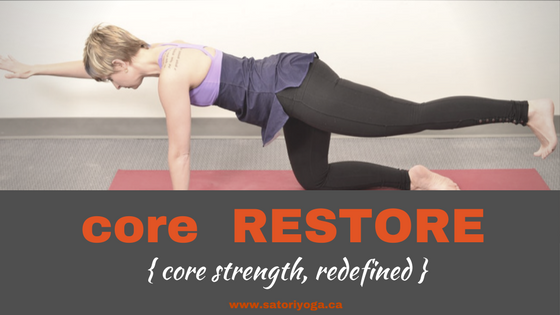
core restore: GOAL + FOCUS


The core is our physical, emotional & energetic center. Its power is not found in isolation but rather in relationship to our whole being and it’s interaction with the world around us.


Working from this premise, our core musculature needn’t be ‘held’ in stabilization but rather activated by the way we move.


To achieve that we are going to focus - consistently and systematically - on restoring awareness and function in the hip joint and all of the muscles surrounding it. 


We will isolate the movements that underlie our most common daily tasks – such as walking and sitting, for example – to build a more functional base for our daily activities.


Our foremost goal  - to begin with - is to learn to release tension and to also begin to recognize where our movements are coming from (as in: what is driving your leg movement as you walk? what stabilizes you as you stand?)


Here is a great test to start with:


Stand in front of the mirror; it might be helpful to place your hands to the front of the pelvis.

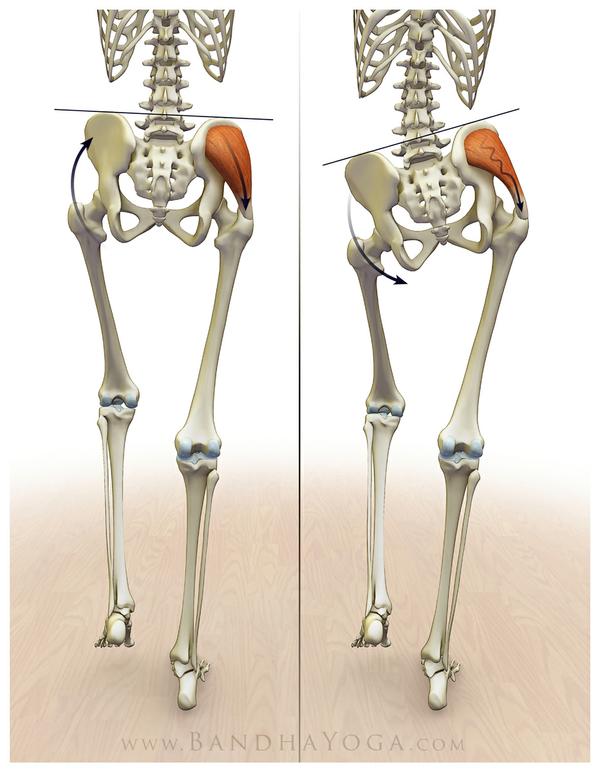
Lift one knee up - just slightly is enough - and observe the changes in your pelvis + rib cage position.


Did your pelvis or rib cage change shape or position when you lifted the knee?
Did your movement originate from the hip joint or someplace else?


In class, we did a similar movement while lying on our backs with the knees bent - this particular position changes our relationship to gravity and also shortens the levers of our legs to make the pure movement (from the hip!) more accessible.


Once you've tried this movement while standing, do the same while lying on your back: start on your back with the knees bent; observe the position of your pelvis and rib cage against the mat. Practice lifting your knees - one at a time - while noting the changes in your body's relationship to the mat. In class we've placed a core ball under the pelvis to improve relationship between pelvis and rib cage.


This is a primary movement of our hip joint - hip flexion - and something we are going to practice for the next several weeks. So, to build a better awareness about your movement patterns, also pay attention to how you sit and walk - do these movement come from flexion at the hip or misplacement of the pelvis and rib cage?
     

    A word on tension:


    Our musculature is arranged in layers around the skeleton, with the muscles closest to the bone being responsible for stability - this is where our stability and balance are fine-tuned!


    Most of us have poor awareness of these muscles (there are reasons for that - we will talk about these later on!), so we tend to use large outer lying muscles for most of our tasks - from flipping a switch to stabilizing the body.


    One of our goals is to learn to initiate the movement from the joints by relaxing the overworked muscles of the exterior. Your movements may seem jerky in your initial explorations, and that's OK.


    Move at the pace of a growing plant.


    Your are freeing the movement potential at the core of your body - give your system all the time it needs to integrate new patterns into your neuromuscular circuitry. Gradually your movements will become smooth.


    Remember: slow is smooth, smooth is fast!


    More on tension and tools to relieve it next week!
    For now, use the BALL 101 printout below to explore + relieve areas of tension.

     
    Additional Printouts / Worksheets:
     
    See you on the mat
    Julia + SATORI YOGA TEAM