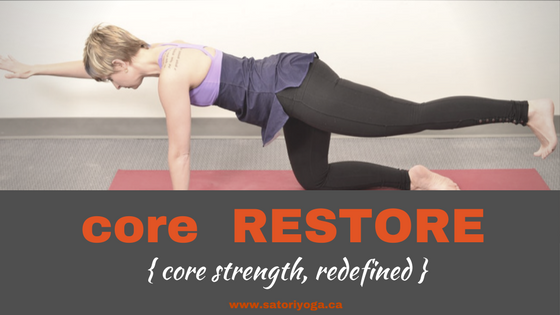
No, I didn't completely lose my marbles {yet, anyway!} and send the wrong kind of message to the wrong kind of crowd.
Sooooo many of you have asked me what
kind of magic happens behind the closed doors of CORE RESTORE class - I thought the easiest way would be to share exactly what we talk about.
So here goes....
Enjoy - and, as usual - all questions are welcome!
This week our theme has been "front to back," as in "what is the relationship between the front and the back of my body, and more specifically, between the muscles at the front and the back of my hip joint?"
Before we dive in, let's review what we already have covered so far:
~ we need active stabilization in every step of the walk – when we transfer weight from one foot to the other
~ gluts are the primary hip stabilizers; if
they are sleepy / inhibited (as in when we spend a lot of time sitting on them!) – we develop wonky compensation patterns and stabilize with tension, thus compromising hip and knee health and alignment. When the gluts aren't doing their job someone else has to - one common strategy is to grip abdominal muscles or hold the breath to execute the movement.
~ healthy gluts support
healthy pelvic alignment and appropriate length of the pelvic floor muscles, especially at the back of the pelvic floor. Tight gluts can and often will contribute to tight back of the pelvic floor (vice versa is also true!).
~ to stabilize well, we need to know how to engage and also release / relax the glut. We've spent a fair bit of time talking about hip flexion and mastering glut release in hip
flexion; moving forward we need to focus on finding + activating the gluts.
Here is what we added this week:
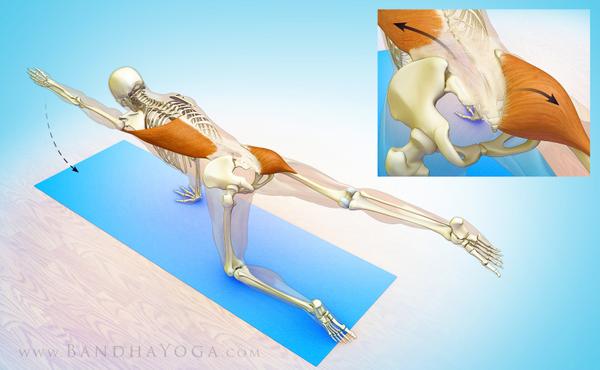
~ gluts work as a reciprocal pair to the hip flexor group: part of their job is to "pry" the
tight hip flexors open.
~ they also function as a primary stabilizer so that we don't have to grip the abs (or other parts) to get where we are going!
So when the gluts aren't active / strong / resilient:
Sleepy gluts can lead to tight hip
flexors.
Tight hip flexors can lead to no hip extension when walking.
No hip extension when walking can lead to unhealthy changes in gait leading to hip, knee, and spine damage.
Who cares and why bother?
Here is what happens in the rest of the body when the hip flexor group (particularly psoas - the long muscle of the hip flexor group that starts deep in the groin and attaches all along the entire length of the lumber spine} is shortened: