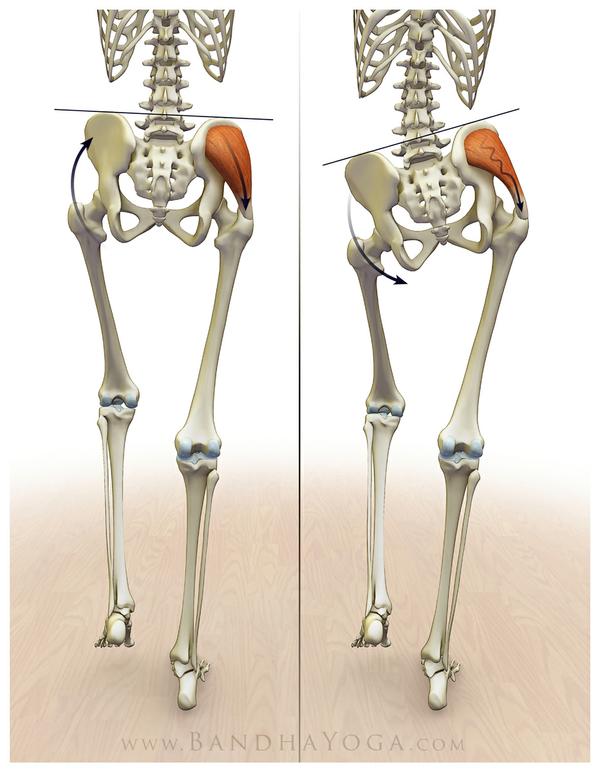
Our musculature is arranged in layers around the skeleton, with the muscles closest to the bone being responsible for stability - this is where our stability and balance are fine-tuned!
Most of us
have poor awareness of these muscles (there are reasons for that - we will talk about these later on!), so instead we tend to use large outer lying muscles for most of our tasks, from flipping a light switch to stabilizing the body.
One of our goals is to learn to initiate the movement from the joints by relaxing the overworked muscles of the exterior. Your
movements may seem jerky in your initial explorations, and that's OK.
Your are learning to free the movement potential at the very core of your body. Give your system all the time it needs to integrate new patterns into your neuromuscular circuitry.
Move at the pace of a
growing plant.
Entering the realm of the felt sense is for many people like entering a strange new land, and land they've often visited without ever bothering to notice the scenery.
Gradually your movements will become smooth.
Remember: slow is smooth, smooth is fast!
HOMEWORK {or HOMEPLAY:)}
The most important thing right now is developing awareness of how you move through the hip girdle. Everything else
is build on that foundation.
Human hip joint has a variety of movements available.
Which ones can you find without compromising the stability of your pelvis:
- Can you move your leg further away from the center line of your body, and then closer to it without moving your pelvis?
- Can you rotate your leg inward and outward without moving your pelvis?
- Can you identify the times that your pelvis moves with the leg?
1. Pay attention to:
- how you sit down / get up
- how you sit when you tired
- how you sit when you are tired but trying to sit correctly
- how you walk up / down the stairs
- how you sit in your vehicle
- how you walk - what moves, what doesn’t
- how you are breathing when you are eating? working? driving?
- where do you breathe predominantly - chest? ribs? belly?
- are there any conditioned habits as to how you "should"
stand, walk, sit, breathe?
2. Hip flexion / stabilization self - assessment { instructions above }: try it on your own in front of the mirror several times {stand both facing and then sideways to the mirror}. Practice observing movement in others - this is yet another tool that can help us develop a better body + movement awareness.
Pay attention to
how you sit down and how you sit in general - do you move through the hip joints or rather tuck the pelvis under and round your back for ease of operation?
4. Gait Assessment: does you walking gait involve moving from the hips (do you feel your leg bones swinging to and fro?) or some other swiveling / swinging / sashaying
movement?
Go for a short walk; slow down so that you can really listen and feel how your body is moving:
- Can you feel your front hip flexing as you step one foot forward?
- For extra brownie points: what are your toes doing? Are they active or passive participants in your walk?
When you walk up the stairs:
- Does your pelvis tilt side to side?
- Do you lean your torso forward as you go up?
- Do you load both legs evenly?
- Can you
pause and balance on each foot / stair?
- Do you look forward or down?
When you walk down the stairs:
- Do your feet / knees point out or forward?
- Do you walk sideways?
- Do you look forward or down?
5. Use Ball Rolling as a way to get familiar with different areas of the body { you might find some hurts you didn't know you have!} and also to relieve / release tension.