Before we delve into today's topic - a mighty and marvelous proprioception - here is a
compilation of Child's Pose variations. In it, there's a Child's Pose variation for every taste {and body shape!}. There's even one you can do in the office!
We've stopped to explore the Child's Pose topic in more detail in the Corrective Movement class a couple of weeks ago, and I thought it would be nice to have
a visual to go with our discussion.
Now back to today's topic!
In class we use ball rolling, movement, breath, and body scanning to
bring our
attention to sensations in different areas of the body.
So, naturally, the question comes up - what the heck for?
I mean, the body hurts already, so wouldn't it be best to just escape pain and focus on something external?
The answer is, "it depends what you are after!"
Escaping pain by diverting our attention elsewhere is a marvelous pain management tool. But while it can certainly help to find temporary relief and calm down the nervous system for the time being, it does nothing to change the very ground of the nervous system.
You know me - I don't do anything lightly.
I want
the tools that I use {and share with you} to be multitasking super heroes.
I don't want a temporary relief. I want a permanent change.
Enter proprioception.
Proprioception refers to the sense of the relative position of neighboring body parts, such as, for example, the femoral head within
the hip socket - and also the muscular force utilized in movement of those parts.
Proprioception is like “GPS” for the joints.
Pause reading for a moment:
- Can you identify the position of your
hip sockets?
- You arm bones in the shoulder sockets?
- The position of each shoulder blade?
Joint position is detected by specialized nerve endings known as “proprioceptors” that are located within the muscles, ligaments and joint capsule and the periosteum
(on the surface of the bones).
These receptors communicate information about the joints to the brain via the sensory columns of the spinal cord {all of this awesomeness happens on the background, mostly without your conscious awareness}.
Studies show that joint position sense is decreased in persons with osteoarthritis. The suspicion is, of course, that reduced proprioception plays a role in
the development of the disease. Indeed, exercises that improve proprioception have been demonstrated to be effective in the conservative management of osteoarthritis {yes, those strange moves we do on the mat - we do them for a good reason; not because I am crazy!}
Furthermore, decreased proprioception is exceptionally common for people who live with persistent pain, and for a good reason.When
your nervous system is so busy sensing pain, it no longer has the capacity for proprioception.
The more pain you have, the less coordinated and more prone to injury
you are. Converse is also true: the more body aware you are, the more
you are able to turn your pain down - it is like flipping the sensory nerve
communication switch, so that pain sensors cannot dominate
your brain
any longer.
Got a free moment?
Use it wisely; body scan yourself!
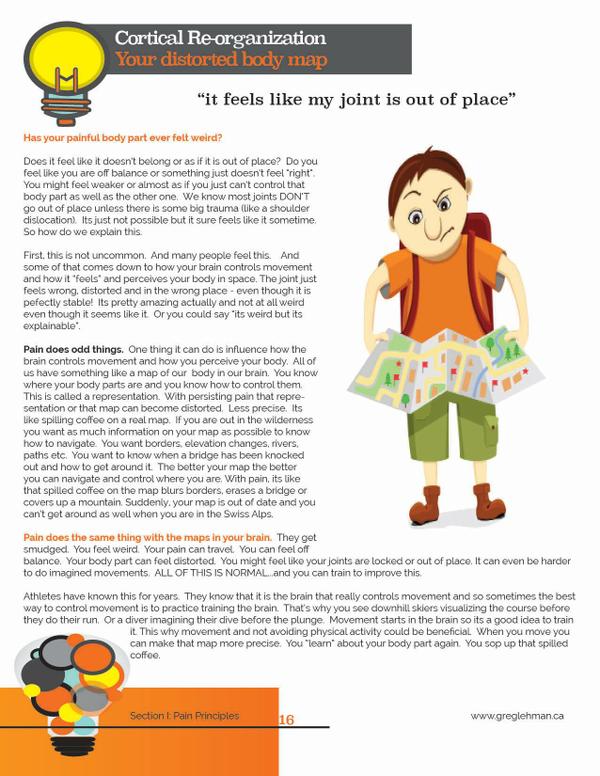
Here is an image that can help you understand how pain changes the way the brain sees / feels the body (a huge thank you to Greg Lehman who
continues to explain how persistent pain changes our nervous system and what we can do about it).