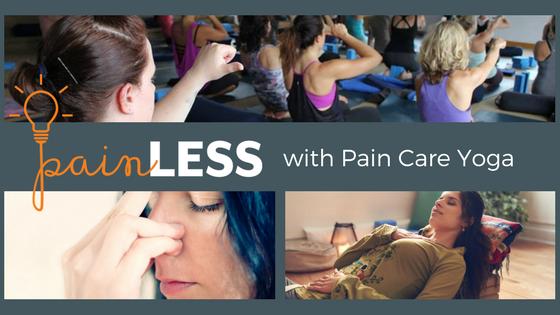
Welcome to your first Pain Care + Corrective Movement e-LESSON.
Our goals are lofty; our mat time together time is short.
Weekly e-LESSONS are designed to supplement your mat practice; to expand your understanding of the new and emerging
science of pain management; and to deepen your knowledge and felt sense of the body.
To get the most juice out of our class time together, please read carefully through included information and do the assigned homework {I won't go overboard with it, I really, really promise!}
A number of recent studies have
proven that a combination of pain care education and pain-science informed movement program delivers best results, and the benefits continue to accumulate over time.
So HERE WE GO!
PAIN as an alarm system:
Your probably are already aware that pain is one of the body's protective mechanisms - pain's job is to alarm you whenever there's damage to the body or when something potentially dangerous is happening.
The purpose of pain is to make you change your
behavior: stop walking on that sprained ankle, nurse that sore shoulder, or stay in bed (usually with a cold - yuck, I know) - when you are run down and exhausted.
Unlike any simple motion detector - or even your house alarm system, the pain mechanisms of the body are extremely complex, adaptable, and always changing.
Imagine now, that there's a sophisticated computer attached to your house alarm system - this computer can analyze the potentially dangerous situation and decide on an appropriate response: not only it is able to decide whether just the lights need to be turned on or a
SWAT team has to be called, but also decide if these were the most beneficial and appropriate actions.
Your brain works just like that extremely sophisticated computer at the end of this alarm system.
However, unlike a simple alarm system, brain has many response options to choose from - pain is just one of them. Nausea, dizziness, muscle weakness, and digestive disturbances are some
of the others.
Because our pain mechanism is so complex, adaptable and ever changing, there are that many things that can go wrong with it.
Have you ever had a paper cut that was so sore it kept waking you up the whole night? I know, I have!
This is but one of the examples how our protection mechanisms can go haywire, and create pain where
it doesn't need to be.
It demonstrates perfectly how the brain can make grave mistakes in accessing the situation.
* Just a note before you delve into the video: all pain is real for those of us who are experiencing it. One cannot simple wish or think the pain away - the approach has to be holistic and multifaceted; in other words - the complex problem of persistent pain requires just as a complex approach to finding relief and / or solutions.
The more we understand how our bodies and minds make pain, the less we fear, and the more tools we have to heal and feel better.
More on that soon!