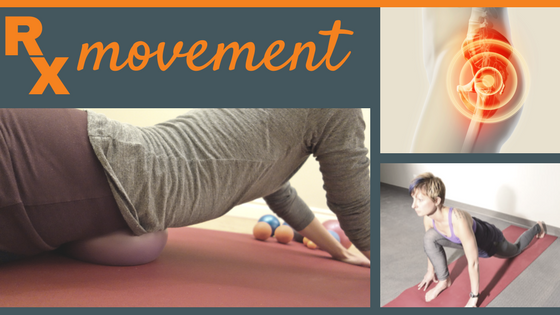
Step 1: Start with your belly on the Core Ball.
This will help to down regulate {calm} the nervous system, which, in turn, can help you work the connective tissue without experiencing too much
discomfort. Global Shear on the ball also helps to mobilize some of the abdominal muscles and allow for easier access to the muscles at the front of the hip.
Lying face down, set the core ball underneath the low belly - between the pubic bone and the navel. If this feels extra tight you can either experiment with rocking the hips side to side - this tends to ease the sensations - or replace the ball with a
folded blanket and use that as a starting point.
Options here include side to side rocking, breathing, contract - release, or breath holds.
Step 2: Release the quads.
Lying on your belly, set a ball {or a ball set - sometimes we use 2
instead of 1 ball - this tends to lessen pressure and therefore sharp sensaitons} under your front mid - thigh.
Start with several long breaths to help your muscles relax.
From there, options are: stay and breathe (especially if sensations are quite strong); contract - release (tighten the muscles of the quad, then release); flossing (bend and straighten the knee).
Step 3: Work the Hip Flexor Group.
We used a soft ball in that same prone position to massage our hip flexors.
Lying face down, set the ball just to the outside of the pubic bone - right where the thigh connects to your torso - and roll up along the inside of the pelvis and up toward the belly button.
A word of caution: this
area can be very sensitive to work, so if you feel uneasy about Step 3, instead spend more time with Step 2 - giving your nervous system a chance to get accustomed to pressure in this area.
Step 4: Proprioceptive Reset.
Anatomically, some of the front hip muscles originate from the spine.
This structure is designed to function as internal suspenders connecting spine and legs.
This next exercise will introduce you to the sense of your hip flexors as internal (and very springy) suspenders:
Put a
couple of chip foam yoga blocks (or books that you don't love anymore) in a doorway, and then stand with one foot on that platform, with the other leg swinging freely from its suspender.
Keep your hips level, and let your hanging leg relax into a gentle swing that requires little or no effort.
Imagine a
suspender attached just behind your respiratory diaphragm ( the area of your bottom back ribs), and your hanging leg suspended from there, swinging freely through your pelvis.
Explore this movement for several moments, maintaining relaxed upper body and even breath.
Now step
down from your platform, and compare the feeling in your legs and hips while standing and walking.
Repeat on the other side (just so you don’t walk in circles for the rest of your day.)
Step 5: Try
out a lunge.
To lengthen front of the hips muscles stack your lunge this way:
Start on hands and knees.
Step your right foot forward – I keep a bolster around to prop up my back knee.
Verticalize the front shin.
Lift your torso to
vertical, and bring your hands to your hip bones (technically, this is the front of your pelvis.)
Stack your rib cage over the pelvis, keeping both in a neutral alignment.
This last step is crucial – if your pelvis + rib cage are tipping and tilting, you are compressing your lumbar spine to create the required shape without getting the benefits. Why suffer needlessly!?
For extra jazz, tuck your tailbone under – this is where my back knee usually starts to complain.
Let me know how that goes!