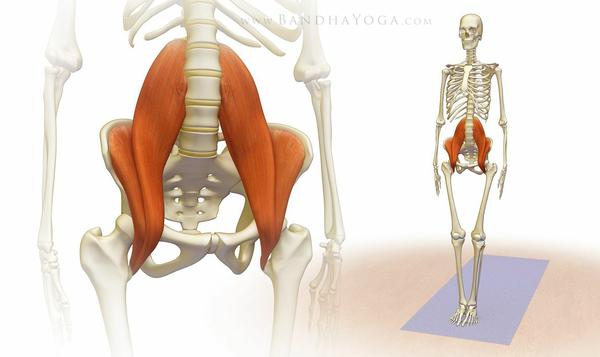
Here is what happens in the rest of the body when the hip flexor group (particularly psoas - the long muscle of the hip flexor group that starts deep in the groin and attaches all along the entire length of the lumber spine} is shortened:
~ Psoas has a lot of influence on the lumbar section of the spine. If / when it is shortened, it can pull the lumbar spine forward, changing the relationship between the front of the body (lengthens) and the back of the body ( shortens)
~ Back bottom ribs might slide down toward pelvis, and also forward, jutting the entire bottom rib cage forward (this will affect shoulder girdle function and breathing.)
~ It can also tip the pelvis forward, creating a more pronounced lumbar curve.
This is, of course if both left and right side are uniformly
short, which, of course, never ever happens. In real life situations all of the above most often will be accompanied by a rotation of the rib cage or pelvis - because one side might be shorter / longer than the other.
In addition to that:
A psoas that won't release
can compress the disks in the spinal column, contributing to degenerative disk disease, prolapsing discs, and damaged spinal ligaments.
Psoas runs the entire length of the digestive system, so tension in psoas can also create a "standstill" in the intestines.
Psoas houses the lumbar plexus - a dense
collection of nerves responsible for innervating abdomen, pelvic floor, deep hip rotators, and most of the muscles of the thigh. Contracted psoas can and will contribute to chronic pain below the deck.
If fact, symptoms of psoas syndrome may include:
(I've experienced most of these. Seriously, when psoas isn't happy, no one is!)
Lower back pain
Pain in the lumbosacral region (between lower back and buttocks) when sitting or changing positions
Pain when trying to stand in a fully erect posture
Pain in the buttocks
Radiation of pain down the leg
Groin pain
Pelvic pain
Limping or shuffling gait
Now that I've scared you
enough, we'll spend the majority of our time together focusing on harmonious engagement through the back and front of the hip joint.
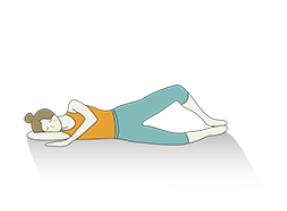
Here are instructions for Wall Clam and Hip Roll:
Challenge yourself with a one-legged bridge if you are feeling particularly keen!
Wait!
Before you get all excited and dive into this week's homework, take a look at this (this image, by the way, serves as a segue to our next week's topic - Breath. Pressure. Stability), or better yet - suck your belly in, hold your
breath, and then test your hip range of motion... especially extension.
You will quickly discover that holding the breath limits your hip mobility.
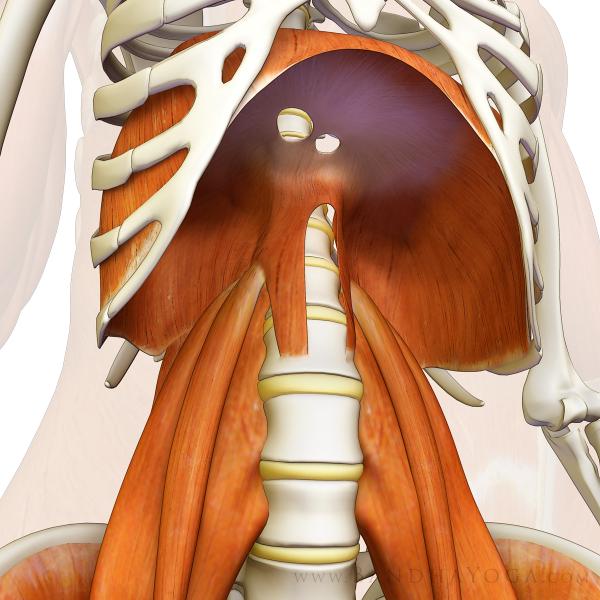
The reason is, yet again, the pesky psoas {technically, it is psoai for plural} and their connection to the diaphragm.
Here is an image of that connection: