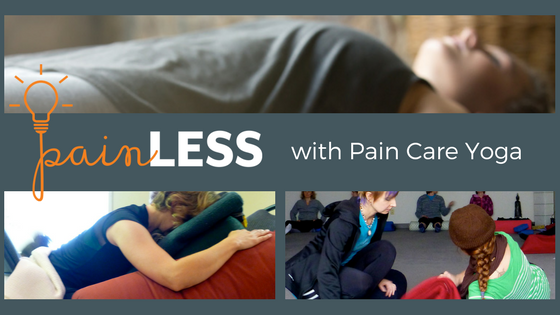
Yoga class is great.
Unfortunately it only happens once a week.
Teri says,
"I really loved this week's class!
Using the ball to tip-twist-stretch was AMAZING!
If I'm lacking something, I think it is
actively integrating what I learn with you into my everyday life so that I change the way I move/sit/stand, etc. to better support my muscles and joints.
Any suggestions for this sort of thing are always appreciated!"
So I thought today - right at the beginning of the long weekend - would a great place + time to focus on how to fit self-treatment strategies into the rest of your week / weekend / life.
First and foremost, let me say this: the struggle is REAL!
Developing a home practice is the hardest thing
of them all.
Most folk struggle with this one {yes, yours truly included} so know that you aren't alone.
For those of us with neurological challenges (this includes anything from persistent pain and insomnia to anxiety and chronic stress) this struggle is exacerbated by the nature of our condition.
If I haven't slept half the night, dragging myself onto the yoga mat or meditation cushion feels daunting. And if something hurts in addition to the nighttime red-eye express, then all I want to do is to crawl back under the covers, even if for extra 5 minutes.
I am not gonna lie, I've done the crawl back thing more times than I care to admit. And I've kicked myself for it every
single time: the simple act of giving up on my promise to myself feels like a betrayal.
Which it really is.
It also makes me feel more unwell than I actually am.
So the first
useful trick I've discovered is to set the bar really really REALLY low. Set the bar so low that you need barely any effort to stick with the program.
What exactly does that mean in numbers?
Committing to 30 minute twice a day meditation practice (a common recommendation) is a bar set impossibly high - a perfect set up for failure. Committing 3
minutes a day twice a day is totally doable.
It feels like I have accomplished something and honored the promise to myself. It also paves the yellow-brick habit road to the next challenge, whatever the next small challenge might be...
Speaking of the next challenge: the second useful trick is to go slow.
New habits, even if they are awesome new habits, take anywhere between 21 and 28 days to establish - this is the time when you are going against the grain, so it is already hard enough.
Give this small seedling
of your new + awesome + healthy habit a chance to take root and establish.
Move at a pace of a growing plant.
Don't rush to throw more changes in: doing so will, in all likelihood, undermine your goal and throw you right back to square one. And if that happens, you will feel defeated - with all the mental nonsense consequences of a defeat. Yuck.
The third useful trick is to find your bottom line.
Or, as behavioral psychology calls it, the bright line.
BRIGHT LINE is a pre-determined non-negotiable behavior.
Take a closer look at your lifestyle habits: you probably already have some bright lines in your arsenal. It could be something as simple as: “I don’t do street drugs. I exercise twice a week. I go to bed at the same time each day.”
Now the trick is to apply BRIGHT LINE concept to behaviors that you want to
incorporate into your life.The goal isn’t to change everything, and all at once, but to take a very clear stand in one small area.
Would you like to start eating healthier?
“Eating healthier” is arbitrary; but “I don’t drink soft drinks,” or “I eat at least three vegetables a day,” isn’t.
Want to incorporate more
exercise into your life?
“I go to my yoga class once a week - no excuses,” can be your BRIGHT LINE to start with.
Establishing bright lines gives you a huge boost in the will power (who doesn’t need a boost in that department?), because the decision is already made ahead of time.
This way you avoid making “oh, just
this once” exception; instead, you get empowered by following the pre-determined way you want to show up in this world. Pretty cool, hey?
Plus, you don’t have to make rushed decisions in the muddy water – so you conserve your will power for when you really need it, and avoid decision-making fatigue.
That's it for starters and for today.
Next week: concrete suggestions on structuring at-home self-care program.
Have a glorious weekend!
I love love love hearing from you!