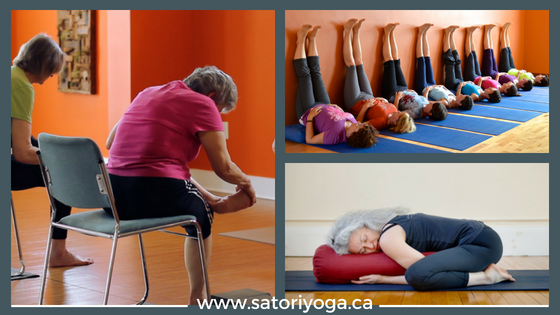
In-Class Experience and the science behind
it:
All Satori yoga classes combine mindful breathing and movement techniques, neurodynamic exercises and nervous system down-regulation practices.
Every single one of our on-the-mat explorations is backed up by some of the newest findings in the fields of pain management and movement. {I research and update what/
how I teach almost daily.}
Chronic and recurring pain, as well as chronic stress, and unresolved trauma, freeze our nervous system in a hyper-vigilant and pain producing state of fight and flight reactivity.
The goal of therapeutic yoga
practice is to help shift the nervous system from those frozen states toward appropriate self-regulation, and rest and digest response so that the body can activate its own healing response.
Pain produces body - wide tension and fear of movement; we begin to move like tin man and women. Therapeutic yoga aims to reduce the fear of movement through off-the-mat pain education and on-the-mat
mindful movement. Multiple recent studies have shown that the best pain reduction results are achieved through a combination of pain education and movement protocols. This would also be the reason behind my writing.
Body sensing and rolling:
Fascia, body's
connective tissue network, serves as peripheral nervous system super highway. Much of what you feel physically is relayed by the well functioning nerve endings laced through the scaffolding of the fascia.
We've used ball work to bring our attention to sensations in different areas of the body, as well as to decompress, untangle and hydrate congested tissues.
As I have mentioned in the class,
ball rolling works on the same mechanism as a TENS machine - rolling stimulates very specific peripheral nerve fibers to reduce pain.
And, of course, it feels so darn nice!
Breath Work:
Persistent and
recurring pain changes the way we breathe.
We hold our breath when we move or getting ready to move. More often than not, we hold our exhale. With time, this pattern of holding or uneven breathing becomes ingrained - we simply no longer aware of how we breathe.
Erratic patterns of breathing contribute to body wide tension, and also continuously push our nervous system into the fight -
flight mode, thus creating a negative feedback loop. Upper body breathing can also contribute to feelings of anxiety, which also perpetuate pain.
Breath awareness as well as simple breathing exercises help us rediscover our breath and use it to mindfully influence our physical body and the mind in a positive way.