Last week of classes in this Core Restore session - holy, time flies!
Registrations for the next set are still open (at the time of writing this) and live here.
So far, we've talked (mostly I talked!) about several factors contributing to our stability. None of them is as important as our breath.
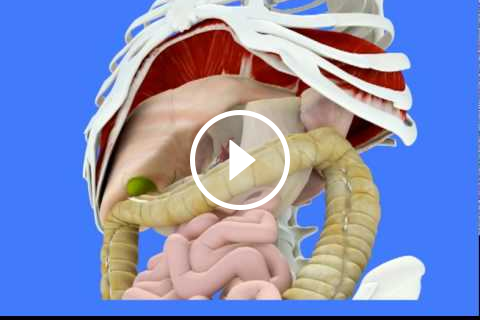
Watch the video to get the visual of full - body breath movement:
3 important heads up for this video:
1. 'tis in French, but the visuals are excellent, so don't be worried about the language barrier.
2. We do not need to full - body breathe all of the time, but we do need to have an ability to
recruit our full breathing system to respond to the demands of the situation - for example, our body's demand for oxygen is much lower when we are sitting or lying down, and much higher when we are climbing stairs or carrying heavy things.
If the breathing is stuck in one forever - mode all of the time, both the nervous and the muscular systems re-pattern themselves and limit our ability to breathe fully.
3. Back ribs do not seem to move in this video, yet in really full body breathing, back ribs also do expand.
Healthy breathing creates a vital structural
support for your back (especially lumbar spine) as well as your shoulders.
Healthy breathing relaxes tight neck muscles, can prevent reoccurring headaches and migraines, as well as assist a better thyroid function.
Healthy breathing can release mid-back tension.
Healthy breathing
massages (no joke!) your heart, lungs, as well as your digestive organs, assisting better digestion and elimination.
Healthy breathing patterns are absolutely necessary in the prevention + treatment of pelvic floor disorders.
So why breathing optimally is so important for stability?
One word: pressure.
The intra-abdominal pressure is what stabilizes our spine when we stand, walk, and move about.
Whenever the ribs shift out of neutral position - for example, move forward and lift in front, they also drop in the back, which, in turn, pinches the back of our "abdominal balloon." That places the content of abdominal balloon under more
pressure, and, like most things under great pressure (most of us know this first hand!), it tries to escape.
This escaping pressure moves either up (potentially creating hiatal hernia and increasing pressure on abdominal aorta), downward ( leading to pelvic floor disorders), or forward to destabilize our structure even further.
It is right next to impossible
to utilize the muscles of the abdomen correctly if your alignment or breathing (now you know how the two are connected!) are sub-optimal.
What about breathing and hip mobility then?
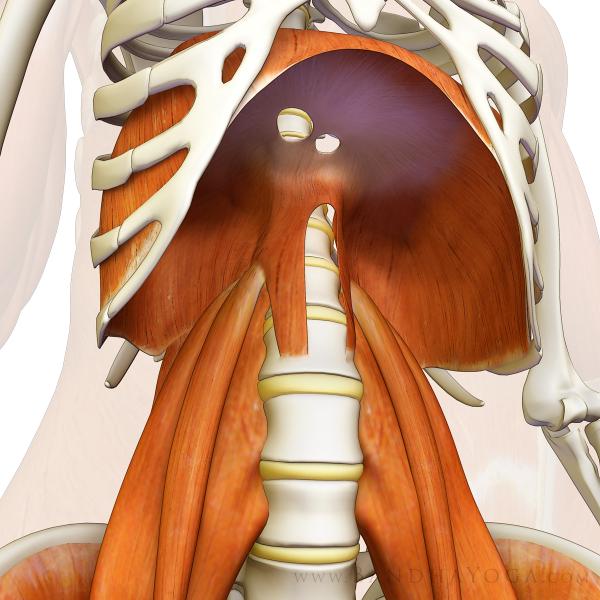
"Legs" of the diaphragm {diaphragm is a parachute - like muscle attached to the
bottom ribs - you can see on the picture below) connect the diaphragm to the spine, and also to the hip flexor group.
Tension in the breath (and especially sucking the belly in) affect our hip mobility because of this intrinsic connection.
Furthermore, because this "crossover" is so very central in
the body, it has the potential to influence a lot of things above (heart, lungs, shoulders, neck) and below the deck (digestion, elimination, hips, knees) through the infrastructure of the connective tissue.
Folk, I don't say this lightly - having suffered the effects of this "crossover syndrome," - my guinea pig of a body have confirmed that adhesion (which is what I had) in this area can
contribute to shoulder pain, heart palpitations, hip tension, knee and even foot pain.
Tracing the chains of connective tissue have helped me to solve "my left side sucks" mystery and move forward with my life. I wish the same for you - this is why I share this!
While working with and on the breath can be a life-long endeavor, recognizing how we breathe is an awesome first step that can carry us far, far, far forward.
And your reader's digest - here is what we've covered in this session:
Moving From The Hip:
Welcome to your first Core Restore e-lesson.
Our goals are lofty; our time together time is short. Weekly follow up e-mails are designed to supplement your mat practice; to expand your understanding of core; and to deepen your knowledge and felt sense of the body.
This week we focused on finding + engaging the gluts - in addition to our "move from the hips" motto - and many students have struggled with isolating / triggering gluts.
So before we delve into today's topic - which is balance + propioception - let's take a look at our sitting habits.
This week our theme has been "front to back," as in "what is the relationship between the front and the back of my body, and more specifically, between the muscles at the front and the back of my hip joint?"
Let's start with a review what we have covered thus far:
Before we delve in to today's fascinating topic a gentle reminder that next week is our last week of classes for this Core Restore Session.
Registrations for the next Core Restore set live here. I aim to start promoting this next set of classes come Sunday, so if you intend to stay with the class please grab your spot
soon-ish, before they all fill out (you know how fast that can happen!)