You also now know that there are no specific "pain nerves."
All body sensations - things like touch, taste, temperature changes, location of our body in space, our relationship to gravity, and yes, pain - are all relayed through the same peripheral nervous system network.
Here is how these pieces of puzzle fit together:
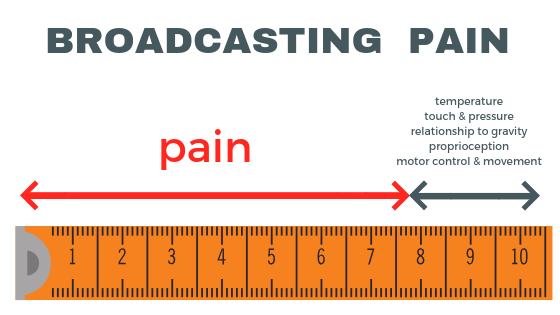
Imagine that peripheral nervous system has a certain broadband width.
While over simplistic, this image helps us gain understanding without getting too deep into sleep-inducing sciency details.
If broadcasting pain messages takes up 3/4 of that width, there's very little room left to carry any other information.
Brain relies on peripheral nervous system to locate and orient the body and its parts, and move the body through space. When peripheral nervous system is busy broadcasting pain, our ability to sense the body and control our movements diminishes. In other words, the more pain we have, the less coordinated our movements are, and the more prone to injury we will be.
Uncoordinated movement (and injuries) give rise to multiple compensation patterns that change the state of our connective tissue. Tight connective tissue further reduces the quality of communication between the brain and the body, and so we find ourselves stuck in the vicious cycle of pain, poor movement and injury.
The simple biological fact is this: there is a mutually inhibiting relationship between pain and proprioception (the felt sense of body in space).
Pain diminishes our ability to propriocept.
Converse is also true: increasing body awareness reduces pain.
The bad news is that no amount of soft tissue work - whether it comes from a massage therapist, physiotherapist, or self ball-rolling - can create a lasting change.
The good news is that training your nervous system to sense the position, location, orientation and movement of your body in space - coupled with a soft-tissue treatment approach - can gradually reorganize your nervous system to broadcast less and less pain, and more and more body awareness.