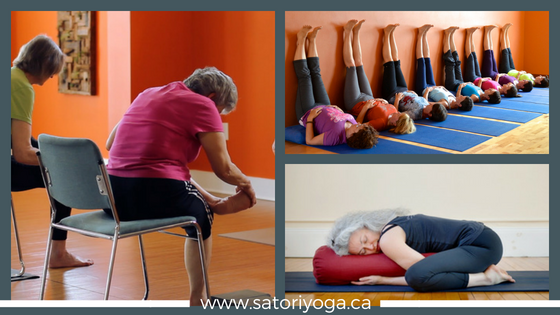
We've spent a lot of November mat time exploring our breath.
In Pain Care Classes we simply noticed if we tend to breathe more into the front or the back of the body, more into the upper or lower half, and whether or not we can feel our breath in the sides of the body.
In Corrective Movement and Ball + Yin classes we've built on that awareness practice by exploring stretches that loosen up stiff connective tissue around our breathing organs, and then taking mental snapshots of "before" and "after" sensations.
Core Restore Classes focused on an added spin of learning how to use healthy breathing to aid stabilization.
Today's e-Lesson summarizes all of practices that we've explored and worked on in the last little while, dotting all the I's and crossing all of the T's in our intellectual understanding of why this is such an important topic. This e-Lesson is written for students of all levels and in all classes.
I find that for me, personally, intellectual UNDERSTANDING is the first step to better body awareness and better movement. If I cannot intellectually understand the reasoning or mechanics of movement, I cannot access that movement. I guess that's learning "movement as a second language!"
It is my hope that today's e-Lesson gives you not only the intellectual understanding and a bird's eye view of what it is that we are working on, but also awareness of how these practices form the foundation for our progress, and future success.
Let's start with an already familiar practice:
Take 5 minutes or so to feel where breath moves most in your body.
Do you feel it more in the chest? the ribs? the belly?
Are you breathing mostly into the front or the back of your body?
Can you feel any breath movement in the sides of the body
Start by lying on your back in a position that feels comfortable; then try the same exploration while sitting (chair is fine!), and finally, standing.
Does your breath shape - shift as you move from one position to another?
So what is the missing link between breath and stability?
The piece that links the two - and provides a vital support to both the hip and shoulder girdles - are the layers of abdominal muscles around our torso.
Core means the musculature closest to the center of the body.
Imbalance in this area places stress on our entire structure, undermining both the foundation and also the periphery of the structure. For moment-to-moment support, our core needs to be flexible, resilient and alert.
When abdominal muscles are held too tense or are too lax they are unable to meet breathing and centering needs of the body.
Let's take a closer look:
You already know that deep, diaphragmatic breathing is essential for pain relief and better health in general. Today I want to challenge your idea of what that diaphragmatic breathing looks and feels like.
The easiest way to cue the diaphragmatic breath is to say "breathe into the belly." Belly breathing is easy to explain, easy to feel, and easy to access, even for a complete beginner.
The "belly breathing" cue almost instantly shifts our breathing from erratic upper body breath to a more regulated, rhythmic lower body breathing.That's great news for central nervous system stabilization!
Belly breathing works exceptionally well to accomplish the goal of diaphragmatic breathing when you are lying on your back.
But what happens when you sit or stand up?
Try this for yourself: stand up and take a full breath into the belly.
What do you feel happen in your back when you do this?
Most people, including myself, feel compression in the mid to low back when belly breathing while sitting or standing. Expanding belly forward pulls our rib cage and often our entire structure forward, destabilizing our trunk. If our abdominal layers are lax most of the time, our structure naturally begins to spill forward, just like it did with a full belly breath a moment ago.
So if belly breathing doesn't work in upright positions, how about tightening those belly muscles instead?
Let's try that!
Tighten your belly muscles and feel the breath.
You will most likely find is that your breathing instantly shifts to chest breathing, so you've essentially lost your ability to breathe well at the expense of tension in the abdomen. I can go on ( and on and on and on) about what that does to our nervous system, digestion, elimination and our ability to move well in the hip girdle, but I won't. At least today.
The middle ground - and the answer to stabilizing the torso while breathing diaphragmatically - is lateral breathing.
Lateral breathing means that your ribs - especially bottom ribs - move.
They billow out - out to sides, laterally - as you breathe.
Lateral breathing allows us to access deep, diaphragmatic breathing without destabilizing the torso. It lets us utilize our abdominal muscles in a controlled manner, creating a dynamic balance between the front and the back of the body, and a solid foundation for a variety of complex daily tasks such as sitting, standing, walking, lifting and reaching.
Lateral breathing is not as easily explained or accessed as belly breath is.
Try it out: place your hands on the sides of your bottom ribs, so that the heels of your hands are right against your side ribs. Inhale wide into your hands - imagine that your rib cage opens out to the sides like pleats of an apron.
More on lateral breathing + ways to find it next week!