Human nervous system evolved in the grassy plains and lush forests of Northern Africa, at the time when one's only chance to survive was either to fight for dear life or to stand shoulder to shoulder with other human beings.
Our surroundings have changed; our nervous system has not.
Stress still triggers the very same ingrained reaction, priming every tissue, organ and muscle in our bodies for intense physical action. We also seek connection - human to human link that builds the united front against danger.
But what if this action cannot be taken because we are chained to a desk or squeezed into a schedule? And what if we cannot lean into another because we are constrained by the framework of "appropriate social interaction?" Where does this intense "fight-flight" energy go then?
Finding our way from the highly activated (and highly adrenalized!) "fight-flight" mode and into the healing hands of "rest-digest" response can feel like an insurmountable challenge, especially if your nervous system has been overwhelmed by chronic pain.
Think about the last time you've tripped over something.
At the moment you were about to fall, you had different choices (even if they didn't feel like choices at the time):
~ you could've braced yourself with tension;
~ you could've relaxed totally and surrendered to the experience of falling.
Our instinct - whether it is bracing against physical instability or life's waves - usually is the first choice, to brace with tension against uncertainty.
We tense to keep our temple as status quo.
When we lose support - when the ground is pulled, literally or figuratively, from underneath our feet - we attempt to defy gravity or resist life's unfolding by stabilizing ourselves with tension.
If this temporary bracing holds long after the fall, after stress and uncertainty have passed, our body accepts tension as its permanent support. The pattern of stabilizing with tension is then rigidified.
Overtime the memory of stress fades away, but tension remains, now gripping and holding underneath our conscious awareness.
The negative feedback loop is created:
Tense muscles and tight breathing (that comes with tense muscles) convince the mind that the body is under attack and needs to be protected.
The brain then rings the alarm bells of the nervous system in the form of fight-flight mode.
Fight-flight mode causes more muscle tension, which, in turn, perpetuates pain and stress.
And so around and around we go, spiraling down into the rabbit hole (no offense, Easter Bunny!).
Whenever tension is our subconscious habit, this habit - unless we are made aware of it - is with us no matter what we do: sitting, standing, walking, lying down, or interacting with others. When the body is locked into the habitual pattern of tension, feeling supported and leaning into that support is a challenge.
Did you find that memory?
How does your body feel when you are supported? Does it feel,
Balanced?
Grounded?
Secure?
Flexible?
Free?
Does your mind feel at peace?
Sometimes - when the memory of ground support is lost under the weight of life's unraveling and when the pain has become our faithful companion - we need to be reminded what being supported can feel like.
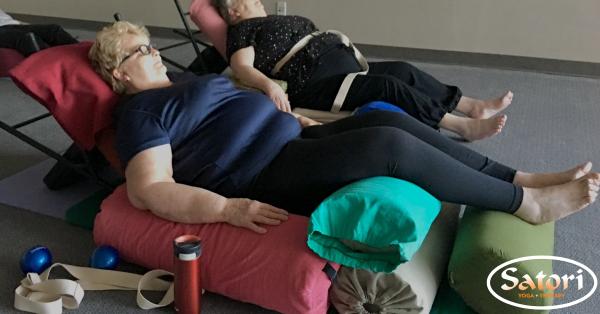
One of the very first things I teach in all classes is to "feel the support;" to know that at least for as long as we are on the mat we are completely supported by the ground; to trust that ground underneath us will hold our weight; to know that we can lean in.
What we are looking for is the forgotten memory of tension - free body.
A place of ease, from which a positive feedback loop can be built.