Last week in a Beginner Core Restore Class I said:
"If you've never been to Rome, how do you know what it looks like?"
I was referring to movement patterns, of course.
Our old, habitual, well-established (and potentially injurious) movement patterns are like our home base. They are so familiar, they seem right.
It's like living in Grande Prairie and never driving further than Debolt.
"Familiar" doesn't necessarily mean "right" or "healthy."
Imagine the experience of driving past Debolt to Edmonton for the first time?
What if we board a plane and fly to Rome...?
It would feel like a different planet altogether!
How do we know what a healthy bio-mechanically sound movement feels like if we've never experienced it before? How do we get ourselves out of the yucky movement rut if we aren't even aware that we are stuck in it?
It all comes back to awareness:
We can't change what we aren't aware of.
This is why each class starts, ends, and moves with body awareness.
This is why I stop often and explain what we are doing - I am trying to help you find a different sensation... a different way to move... a different feel...
It's like I'm trying to show you what Rome might feel like through snapshots, and sounds, and stories, so that you gain sense of something that is maybe just outside of your current body and movement awareness.
Furthermore, the ability to sense the body (proprioception) and the ability to move well (motor - control and kinesthetic intelligence) are the flip-sides of the same coin - the motor-sensory branch of the nervous system.
Dig deeper, and you'll find studies showing that folk who live with chronic pain have a diminished capacity for proprioception. Same studies report that re-building the felt sense of the body reduces pain.
Pain Care Yoga and Core Restore Lessons for this week:
Our e-lesson theme is proprioception.
Yoga Q of the Week:
While a lot of students think of Savasana as a well-earned "nap time," many prominent schools of yoga consider savasana to be one of the most - if not THE MOST - important posture in yoga repertoire.
Q: What exactly is the point of SAVASANA?
A: Savasana is the final relaxation pose of a yoga class.
Savasana is the practice of relaxed alertness.
Executed correctly, Savasana delivers benefits way beyond that of a simple nap {and I love naps!}
How many times you got so relaxed in Savasana that you drifted off to sleep?
How many times you felt antsy, unable to settle down?
It takes time and practice.
Eventually our nervous system learns how to function outside the limits of hyper-adrenilized, frazzled state of rushed schedules, dead lines, lack of sleep, and persistent pain.
We learn to be able to relax yet stay alert.
We learn to feel sensations yet not tense up.
Ultimately, Savasana builds resiliency - an ability to not only function with relaxed awareness, but to return to that relaxed awareness whenever our life circumstances force us off balance - and to know what that balance feels like...
Once the feeling of alertness while relaxed is experienced, we can carry it through and cultivate it in our movement practice, and, eventually, in our life off the mat.
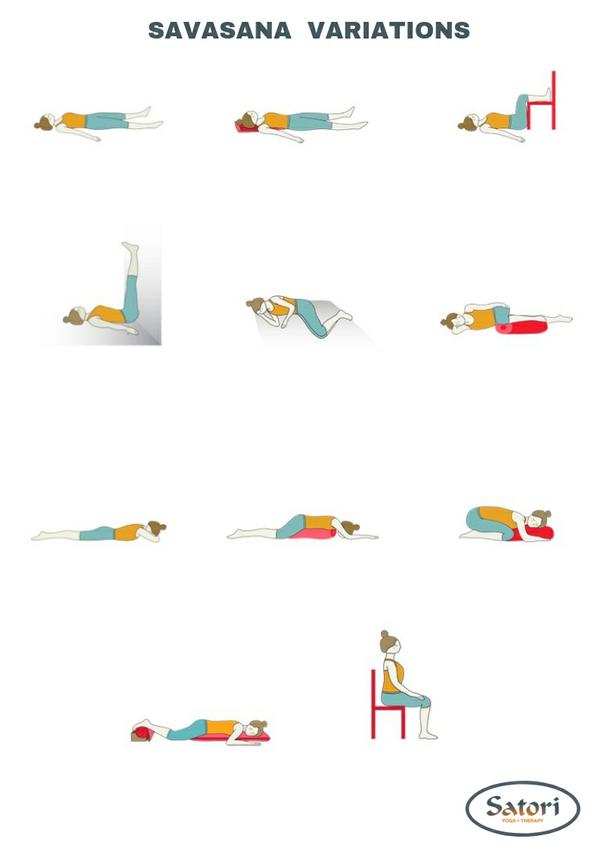
Starting Savasana in a position that feels comfortable is a great first step toward building body awareness and also receiving the full benefit of Savasana practice. (Did you know that correct use of props calms the frazzled nerves?)
Lying on your back is just one option.
Here are some other ones - these can be also used at the start of the class for breathing and centering part of our practice: