Dear , Welcome to Satori May e-blast! Do you or someone you know live with chronic pain?
Then you know how persistent pain traverses every area of our lives, affecting our sense of physical and emotional well-being, energy levels, sleep, mood, and relationships. Worse yet, it instills fear - never ending, gripping, exhausting fear of what if: what if it doesn't go away, what if it gets worse, what if it comes back, what if, what if, what if...
Living with pain creates this certain level of disconnect, almost a distrust between our minds and bodies. It is as if mind and body are sitting on the opposite sides of the fence waiting to play a nasty trick on each other. This edition of Satori e-news is an invitation to get re-connected with your body and maybe, just maybe, consider a wider perspective while choosing your rehabilitation options.

MAY EVENT CALENDAR
YOGA CLASSES AND WORKSHOPS:~Summer Yoga Punch CardsPRETTY to look at, GREAT to gift, AWESOME to use. Each card is good for any 5 classes. Get yours now!
~ Meditation And Other Essential Tools For Inner PeaceWhy is it SO EASY to start meditating, and OH - SO - DIFFICULT to keep it up? Saturday, June 8, 9:30 AM - 12:00 PM. Claim your spot!
According to a study published in the Journal of Neuroscience in April 2011, brain scans of parietal lobe (region of the brain associated with limb movement, understanding speech, and sensing pain) demonstrated that meditation can dramatically reduce sensitivity to pain - even more so than morphine.
~Woodland Yoga And Meditation
Mmmm...Fresh - air yoga...Walking meditation...Your best summer Sundays are waiting for you!Sundays, June 9 - September 8, 9:30 AM - 12:00 PM. More information and registration.Latest research from Japan has shown that spending time in nature boosts the production of good - mood neurochemicals, reduces harmful effects of stress, and lowers the blood pressure.~ Spring Yoga Session is going, going, going, all the way to June 6. ~
Private Consultations are also on-going. Schedule yours here.
YOU THINK YOU KNOW PAIN?
There's a great number of different theories regarding the mechanism and treatment of chronic pain, sometimes one in direct opposition to another. In fact, recent research has shown that many people living with chronic pain, as well as practitioners specializing in pain management, do not have a clear understanding of chronic pain. Let's get started with a quick check in - TRUE or FALSE? 1. Pain only occurs whenever you are injured.
2. Worse injuries result in worse pain.
3. Chronic back pain is an indicator of a weak back.
4.
Chronic pain means that an injury has not healed properly.
5. The body tells the brain when it is in pain.
6. All other things being equal, an identical finger injury will probably hurt more in a violinist than a yoga teacher.
7. It is possible to control pain without medications or surgery. Scroll to the bottom of the newsletter to check your answers.
If you live with chronic pain and ever wondered: ~how do my postural habits contribute to my aches and pain?
~ what about my daily activities?
~is it OK to exercise and what kind of exercise is right for me?
~what happens in my body when I am stressed?
~is medication my only option?
~I'm already seeing a chiropractor and a massage therapist, WHAT ELSE CAN I DO?
Then you cannot miss out on the valuable information that can help you start radically changing your health now! Back pain and other musculoskeletal conditions often result from unconscious habits - things we do every day: you may sit on a chair that makes you slump, carry things with bad biomechanics, or breathe shallow, overusing the muscles of your neck and shoulders. And while physiotherapy, chiropractic care and massage are great for temporary relief, they DO NOT change the way you move. At the very root of yoga therapy is postural and movement education, but benefits go deeper than that: yoga allows you to connect more deeply with your body and develop a sense of the underlying cause of what's going wrong. Once you quiet down enough to sense whatever it is that you are doing wrong, be it bad biomechanics, poor lifestyle, chronic stress, or whatever, you can undo those habits and things tend to improve. Join me for a
yoga class or a private consultation to start learning which postural habits are contributing to chronic pain and stiffness, and how to erase those old, inefficient patterns of movement.
10 years ago I was exactly where you are right now - mentally and physically exhausted by chronic pain from various inflammatory conditions. At the tender age of 32 I had already developed an ulcer from continuous use of NSAIDs. There were days when I couldn't get out of bed, when climbing a flight of stairs felt like summiting Everest. I've ingested vast quantities of supplements and oscillated between my physician, chiropractor, acupuncturist and massage therapist in hopes of finding at least some relief. One of the books on back pain suggested trying a yoga practice, and I never looked back. I went from being frustrated with my body, feeling lost and not knowing what to do, to enjoying every moment I live and move in my body. I still pinch myself sometimes!
I didn't just get better overnight, and Lady Luck has nothing to do with how I feel today. There is a process to healing, and ever since I learned the tools, and started using them, I've been on a steady boost to my best health and passionate living, every day. I did it, and I can teach you what you need to be able to do it, too. I am asking you to suspend disbelief just long enough to try a few session of yoga and let your experience tell you whether to continue. If you find yoga brings you nothing, you won't have lost much. But if you find the experience as eye - opening as I have, you have a whole world to gain.
WHAT SCIENCE SAYS:
Just this year, an article published in Clinical Journal of Pain looked at the overall effect of 10 studies on the effect of yoga for chronic back pain. Another article in Musculoskeletal Care reviewed 17 studies involving more than 1,600 people with either low back pain, osteoarthritis, rheumatoid arthritis, kyphosis or fibromyalgia. Both reviews found that consistently, across all studies, yoga to have a positive effect in terms of reducing pain and stiffness.
|
Beating of a mother's heart, wind's whisper through the trees, melody of running water...
From the moment we are conceived, our lives are filled with rhythms and sounds. And since the conception of humanity, traditional cultures all over the world have been inspired by the transformative power of sound. Shabda yoga, the yoga of sound, uses mantras - sound formulas - for healing.
"Celestial Physician" mantra: this mantra is used to find a path to appropriate healing method for any health problem:
OM SRI DHANVANTRE NAMAHA (Om Shree Don-Von-Trey Nahm-Ah-Ha)
"Salutations to the being and power of the Celestial Physician"
"Ganesha Mantra" is used for removal of obstacles:
OM GUM GANAPATAYEI NAMAHA ( Om Gum Gun-Nuh-Puh-Tuh-Yei Nahm-Ah-Ha)
"Om and salutations to the remover of obstacles."
Traditionally mantra is repeated 108 times, once or twice a day for 40 days.
|
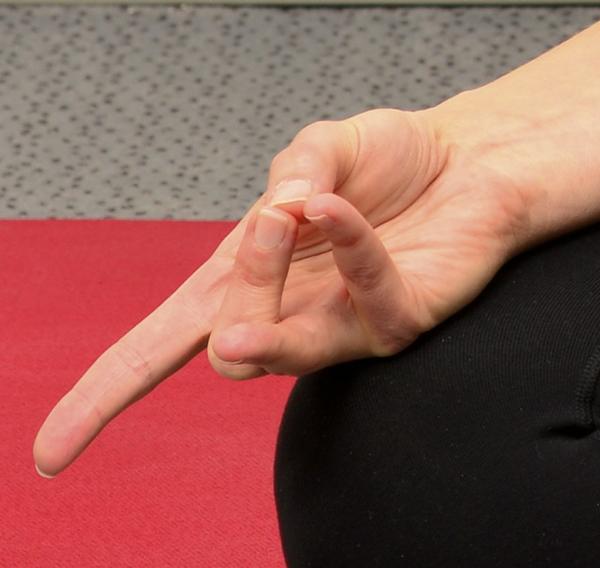
Chanting is often accompanied by mudras - hand gestures of yoga. Mudras direct the flow of energy to enhance the potency of mantras.
BACK MUDRA:
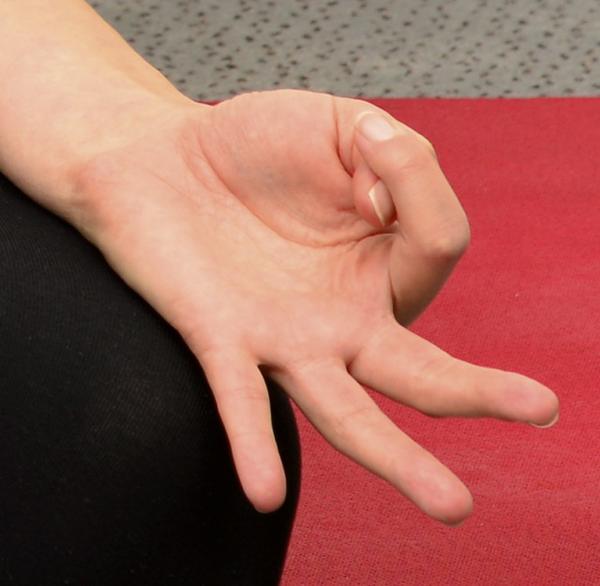
This mudra is effective for strained back, back tension and cramps. You can practice it sitting down or in constructive back - rest position: lie on your back and place your calves on the chair ( your hips and knees bend at about 90 degrees), and nod your chin slightly toward your chest.
Right hand: bring your thumb, middle finger, and little finger together. Extend your index finger and ring finger. Left hand: Place your thumb joint on the nail of the index finger.
Practice 4 times a day for 4 minutes. Or, in case of acute complaints, until it has an effect. Keep your awareness on your breath or silently repeat one of the mantras from above.
In previous editions of Satori newsletter we've discussed how adjusting our diet can help us to optimize digestion, deal with seasonal challenges and sudden stresses, and improve our health in general. Indeed, diet plays a central role in Ayurvedic approach to healing. Yet, Ayurveda has much more to offer.
|
|
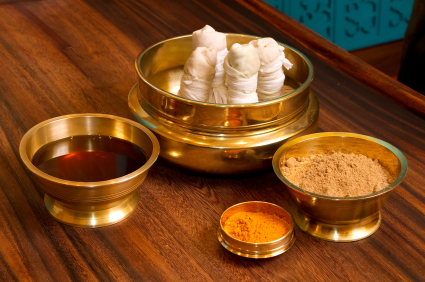
One of the most potent auyrvedic healing tools is a daily self - massage, known as abhyanga. When stimulated through touch, your skin releases a pharmacy of healing chemicals that improves circulation and muscle tone, supports immune function, improves sleep and slows down the aging process.
Here is how:
This entire massage requires just a few tablespoons of warm oil. Use a neutral oil, such as jojoba or sweet almond oil.Traditionally, herbalized oils specific to each doshic type as well as the nature of imbalance were used. Book your private consultation to learn more about dosha specific treatments Begin by massaging your scalp, using small circular motions. With gentle strokes apply the oil to your forehead, cheeks and chin, then move to your ears. Slowly massage the back of your ears and our temples - this has a soothing effect on your nervous system. Massage a small amount of oil onto the front and back of your neck, then move to your shoulders. When massaging your arms, use circular motion at the shoulders and elbows, and long back-and-forth motion on the upper arms and forearms.
Using large, gentle circular motions, massage your chest, stomach, and abdomen. Use up -and-down motion over your breast bone. Apply a bit of oil to both hands, gently reach around to massage your back and spine as best you can. As with your arms, massage your legs with a circular motion at the ankles and knees, using a straight back-and-froth motion on the long parts. Use whatever oil left to massage your feet, paying extra attention to your toes. Sit quietly for a few moments to soak in the oil, then proceed with caution into the shower or bath. Do not use any harsh soaps to leave a thin, almost imperceptible film of oil on your skin. A brisk, invigorating massage is a great way to start your day, while a slow, calming one will soothe overactive mind before bedtime.
TEST YOUR UNDERSTANDING OF CHRONIC PAIN
1. Pain only occurs whenever you are injured.
FALSE: it is possible to injure your body without experiencing pain and it is also possible to experience pain when there are no danger messages coming from the body. 2. Worse injuries result in worse pain.
FALSE: pain is not an accurate indication of tissue damage
3. Chronic back pain is an indicator of a weak back.
FALSE: pain is not a accurate indication of tissue health 4. Chronic pain means that an injury has not healed properly.
FALSE: damaged or abnormal tissue is not sufficient to produce pain, or chronic pain. 5. The body tells the brain when it is in pain.
FALSE: from a holistic perspective pain is related to thoughts, emotions, behaviors, attitudes, beliefs. Pain system is an alarm system - it can warn you when you have been damaged, or when you are approaching damage, but also when you are in a situation similar to a past experience in which you have experienced pain.
6. All other things being equal, an identical finger injury will probably hurt more in a violinist than a yoga teacher.
TRUE: we all have neurons in the skin that send information to the brain about the quality of sensation; chances are our violinist will have more brain mapping connected to his or her fingers, and therefore will receive more sensory input. 7. It is possible to control pain without medications or surgery. TRUE: recent research and clinical studies have shown that it is possible not only to control chronic pain with yoga, meditation and dietary changes, but actually reset the chronic pain mechanism.
SUMMER e-BITS:
I usually scale down on writing during summers - after all, who wants to stay inside when the sun is shining! BUT this summer I am traveling to quite a few different (and super exciting) training with master teachers, and I'm soooo looking forward to sharing what I have learned with you - through e-news, Facebook, and on the mat. Stay tuned for more!
|
|
|