Welcome to Movember edition of Satori e-news. This e-HUG is about yoga for guys, thought-chatter behind our decision making process, and an excellent yoga pose that's great for everyone – anytime, anywhere. Oh, and before I forget -
winter session registrations for all classes (including brand-spanking new restorative yoga) open on November 26 (on November 17 for all currently registered Satori yogis.) Shall we?
Yoga for Dudes:
Even though I am very familiar with traditional roots of yoga -
Did you know that
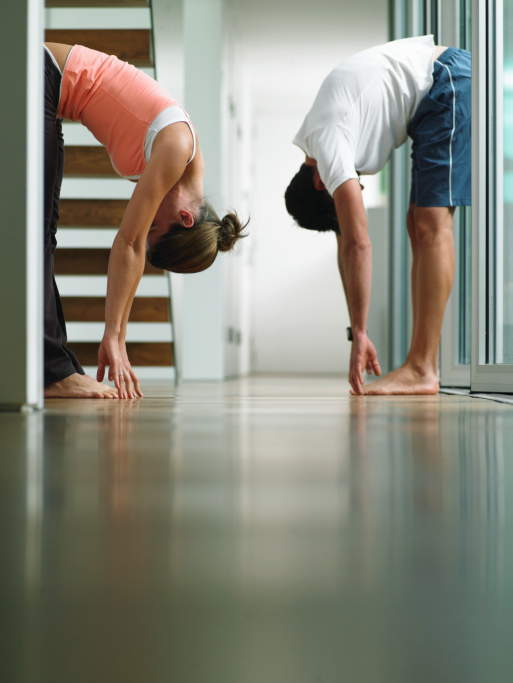
in India, where yoga was invented and developed, mainstream yoga has traditionally been a male-dominated practice? Believe it or not, the overwhelming majority of those teaching, preaching and practicing yoga have always been men,
- when I sit down to write a blog post or a newsletter, I frequently choose topics that might be appealing to my female readers. North American men often shy away from yoga practice. In our culture, women have been
the driving force that brought yoga popularity and recognition it enjoys now.
Well, I am happy to report that things are a-changing, and in a hurry.
Even though studio classes are still predominantly women-driven, many of the corporate classes (yet another new age yoga conundrum) I teach are now mostly male, and demographic of private classes is evenly balanced between men and women.
In just the last few
months, ultra marathoner (he runs some pretty crazy 700 mile races) came to rehabilitate his knees and prepare for the next adventure. Busy oil-field exec decided to give yoga a try to get a handle on stress, and regain some sense of control over his life. Construction business owner discovered that yoga limbers him up so he can play football with his son. New retiree learned to breathe better – now his workouts are way more effective, recovery time is way shorter, and his "cross-fit
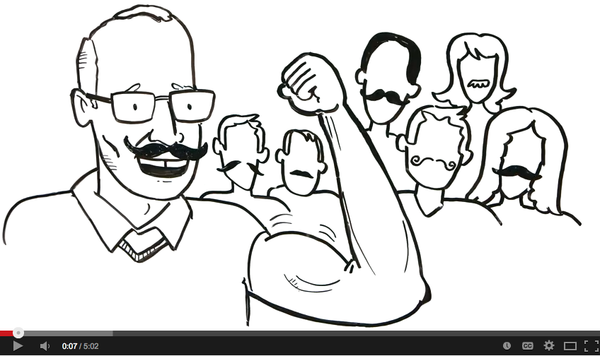
coach finally stopped yelling at him"! More and more men are discovering yoga, and for a good reason: not only yoga has proven beneficial for a number of disorders affecting male population (prostate issues, for example), yoga also fits remarkably well into "life-long stay active" plan, AND helps to rehabilitate indiscretions of our younger days. Did you know that Movember.com identified "staying active" as one of the most important factors in achieving and maintaining good health? Check out this cool video from Movember's Bro, Dr. Mike (it is really cool, I promise!) This has been a huge learning curve for me – for years, I’ve worked primarily with women. Teaching men made me realize something really important: men and women may approach
life and cope with challenges differently, yet the reasons we come to yoga are all the same: we want to hurt less, sleep better, enjoy life more, and generally feel at home in our bodies. And yoga delivers! You don't have to trust my word (yes, I am teensy bit biased) - come and check out a class; if group class feels intimidating to start with, book a private appointment (you can get in touch with me right here); at the very least, try OM ALONE - a home yoga program designed specifically for yoga newbies - or the lovely Legs -Up-The-Wall pose (read all about Legs-Up-The-Wall
below).
Hold on just a second! Before you dash off to find a yoga mat, let's take a good look inside decision making process - who, what and how is informing your decisions?
Deep Knee Squats or Who Is Influencing Your Decisions?
We encountered this lovely old lady while soaking our sore bits in the healing waters of Miette Hot Springs after pre-thanksgiving turkey trot (I meant a quick 8 km hike). She was doing shallow water exercises right in front of us: pools get well used over holiday weekends,
and free space is usually at the premium. Inevitably, everyone cozies up to his or her neighbors; oftentimes, interesting conversations ensue.
“Do you already do deep knee squats?” she asked. My curiosity was instantly peaked! “ I just heard about deep knee squats on the radio,” she continued “ and THEY said it is the best thing you can do for your hips and internal organs.”
What is going through your
mind right now? Are you smiling to yourself, thinking about how silly this sounds, or wondering if you, perhaps, need to be doing deep knee squats?
My thoughts, as it often happens, scurried in two seemingly different directions:
~From one side: how powerful our words are; and how important it is, especially for those of us in the healing profession, to be impeccable with our language. How do we, as health educators,
encourage inner inquiry without influencing or imposing our own opinion onto our students, clients and patients?
~ And the other: how often do we depend on information from “trusted” sources – radio, newspapers, magazines, social media, doctors, therapists, our family and neighbors – without ever cross-referencing it, and, more importantly, without checking with what should be our most reliable source – our gut sense? When and why did we stop trusting ourselves and
started to trust “the experts?”
I have discovered that whenever I feel discomfort in my body, I tend to "replay" words of those "experts" instead of listening to my own sensations. It takes a tremendous amount of effort to stay focused on what I am feeling and not get wrapped up in the "story." How about you?
DAILY PRACTICE: Legs-Up-The-Wall Pose
What if you could quiet the mind and prepare your body for restful sleep, all the while alleviating symptoms of hormonal imbalances (andropause, menopause, peri-menopause, PMS and general teenage moody crankiness), reducing water retention in the feet, preventing varicose veins, detoxifying
pelvic organs, and toning the thyroid gland? Add here stimulating and stretching back of the body, revitalizing heart and lungs, and reducing mild hypertension. Wouldn’t it be awesome if you can do all that in one fell swoop, in about 15 minutes a day, and at almost zero cost?
Those of you who attend my classes regularly are probably going: “ Ok, Julia, which pose are you talking about?”
Indeed, you can access all these benefits (and more!)
in one simple pose. Unlike modern medical science, which targets an isolated symptom and then attempts to manage the negative side-effect aftermath, yoga and yoga therapy are intrinsically holistic in their nature. Yoga poses influence our bodies in a multitude of harmonious ways, and, as you can see, I can get quite carried away talking about them. Well, enough chit-chat!
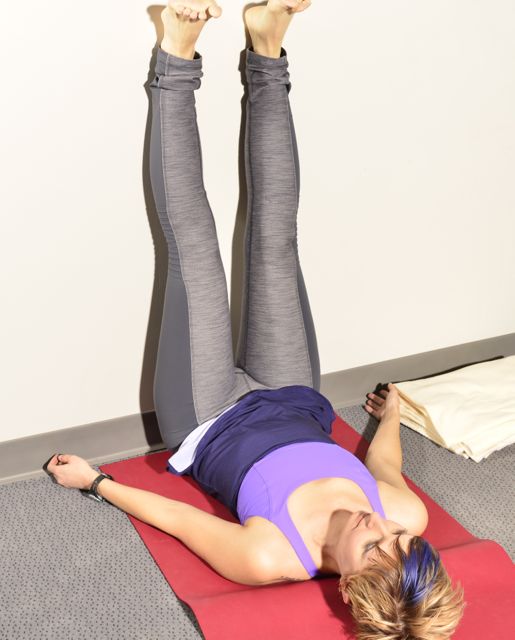
Pose I am talking about is Viparita Karani, also called Waterfall, or Legs Up The Wall.
The last couple of weeks we’ve been using different variations of Legs Up The Wall to end our group practice – I like to include this pose in all evening classes because it reduces systemic effects of stress (try it after an especially busy day when it feels like you had to run in 20 different directions all at once), and promotes restful sleep.
Because I just invited you to question your sources, I will say this: Legs-Up-The-Wall pose been used by hundreds of practitioners
(including myself and my students), who have, in fact, enjoyed the benefits I've described in the above paragraph; it's been researched and documented at length in a variety or books and papers. It is exceptionally safe. Yet, you are the only one who can decide whether it is a right pose for you to practice. I invite you to approach this and any other pose with a spirit of inward curiosity. This particular post was written as a more in-depth introduction to Legs Up the Wall for Satori regulars,
who are familiar with the feel of the pose, as well as mechanics of getting in and out of the pose. If you are new to practice, it is best to experience this and other poses with a guidance of teacher well versed in the art of propping and adjustment.
Well, are you ready?
You will need a couple of firm blankets, a yoga strap or belt, and, of course, a wall. Other possible variations include a chair
and a bolster.
Setting up: plan for 15 – 20 minutes of uninterrupted time (turn your phone off!) in a warm, softly lit room. Home spa comes to mind, doesn’t it? You’ll feel like you’ve spent a day at the spa by the time you are finished, I promise! Place your props nearby so you can access them easily.
~Sit with your hip and shoulder close to the wall (sideways to the wall). Roll
back, and simultaneously swing your legs up the wall. This may take a few tries to get right and feel comfortable.
~Once you’ve got yourself situated, evaluate how you feel. Which parts of your body fell comfortable? Which don’t? Which ones are screaming "bloody murder"?
3 most common discomfort zones are neck, low back and backs of the legs (I am, of course, generalizing – variations are a many; these 3 are the ones I most often see
in class and with private clients.), and, interestingly enough, all 3 stem from the same imbalance - come to the class to learn more:)
This is when props come into play:
- If it feels like your head is tipping way back, and there’s tension or compression at the base of your skull, back of the neck or upper back area, adding a blanket under your head will offer much needed support. Place a single fold blanket under your head; you may also
roll up the end of the blanket to support under the base of your neck (C7 area) and tops of your shoulders, if needed.
- For tension in the low back a single or double folded blankets are best. Position the blanket(s) under your buttocks. Check to make sure that the back of your pelvis rests in neutral position: your pubic bone is not lifted higher then your hip bones (ASIS for those of you anatomically inclined), there’s no tension around your tailbone, and your buttocks are not
contracted.
Another useful variation is adding a strap around the thighs, right below the knees, to support slight internal rotation of the legs: this creates more space at the back of the pelvis. Position your legs about hip width apart, tighten the strap, and let your legs rest into the strap.
- Finally, a couple of different variations for those of you with tight backs of the legs: you can move your legs away from the wall and bend your knees slightly (if you
have a yoga bolster, place it behind your legs for added support). I also like using chair modification: instead of taking legs up the wall, bend your knees, and place your calves on the chair. Chair adaptation works particularly well for those with chronic back pain.
Staying in the pose: most important thing to remember is that this is a relaxing pose, not a
stretching one. Forget the world outside; allow yourself to feel fully supported, and rest. Coming out: spend anywhere between 10 – 20 minutes in this pose. To come out, bend your knees, roll to your side, and stay there for a few moments. Enjoy your practice!
Happy Movember! Get moving, and come to moga (mustaches + yoga). Enjoy our sunny
fall weather while it lasts. FYI, snow can be fun, too - more on that in December e-HUG!
With love,
Julia |
|
|