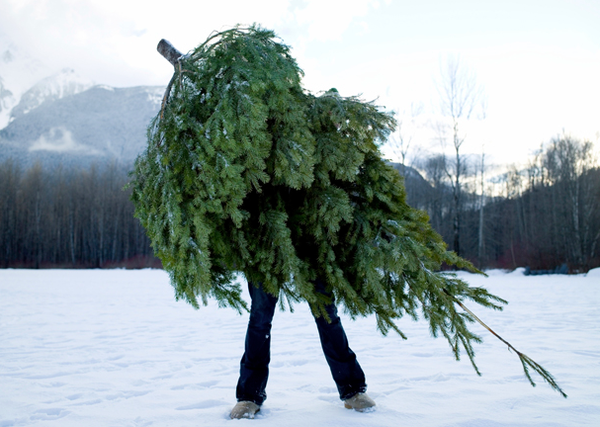
"Pain is like the light on the top of a Christmas tree - there's a lot going on in and around the tree."
~ Explain Pain by David Butler,
MAppSc, EdD and Dr. Lorimer Moseley, PhD, FACP
Stress and pain are rather unusual topics for a Christmas newsletter.
I look through a week’s worth
of holiday mail: the bulk of it holds enticing pictures of pre-Christmas sales (curiously, Yoga Alliance is in that batch), newly-invented healthy recipes (tofurky, anyone?), festive decorating ideas, or, at the very least, warm places with white, white sand and blue, blue ocean to run away to. Isn't it wonderful to get lost in the holiday magic? Yet anyone who has driven in a blizzard, looked for mall parking, or navigated the crowds in Costco on a Friday night knows full well that
stress remains the invisible puppet master behind the scenes of our holidays. In fact, a full 44% of Canadians report higher stress levels during Christmas time.
Cold weather is not kind to our bodies; stress makes the pain even worse. Stress over-sensitizes our nervous system, so we FEEL more pain; adrenaline and cortisol - stress hormones - dampen our body’s ability to produce natural pain killing substances. Persistent pain causes more stress… you get the
picture. I suppose I could write about asparagus tart (mmmm… creamy ricotta and caramelized asparagus), or maybe pomegranate molasses – experimenting in the kitchen is one of my very favorite past times. I think I’ll save these delightful tidbits for February, when the inspiration factor is low. For now, I’d like to keep things real, and focus on stress and pain – a pair of “KILL JOY” partners in crime.
In this
newsletter you’ll find a first-hand account of a mental hurricane, 3 things you quite possibly didn’t know about pain (I definitely didn't!), and 5 strategies to stress-ease your Christmas. So make a cup of turmeric tea to give that lingering head cold a swift kick (1 tsp of turmeric, 1 cup of hot water, lemon and honey to taste), pull up a comfy chair and put your legs up - this e-bit is as wordy as ever:) Not quite Carolina Hurricanes:
“I feel deflated, defeated,” I complained to my sweetheart “ Downright depressed… and so tired. I plain just don’t know what to do!” I won’t bore you with a sequence of seemingly innocuous
events that lead to thy meltdown, but I will say this: not only I loathe mental muck; I fear it. For a control junkie like myself, having mental faculties possessed by something apparently uncontrollable is utterly terrifying. My thoughts felt hijacked (once again!) by the ruthless band of old doubts and fears. One small stress after another crowded out any voice of reason, and clicked a switchboard somewhere deep inside of me; suddenly my brain, like a derailed train, sped up on a
collision course with the inevitability of a steam locomotive. I felt trapped, powerless to do anything but watch all too familiar mental scenery fly by…
You see, I spent most of this fall learning about the nervous system. In restorative yoga training we compared signs of normal function (optimal effort, optimal action, optimal rest) to symptoms of hyper – and hypo active nervous system. We learned how to use yoga practice, particularly restorative yoga ( register for restorative yoga class here), to gently coax an out of control nervous system back to its balanced state. In Pain Care Yoga
( Tuesday Therapeutic class is transitioning to become Pain Care Yoga; register here) module we focused on neuroplasticity – how our
brain coauthors pain we feel in our bodies – and ways in which yoga and meditation practices can lessen it. So in other words, I knew the theory, I had the facts, I used the tools, and practiced the practices. Yet here I was, having a complete meltdown over a supply order that was stuck in customs and a burnt out kitchen light. Of course the first question anyone would ask herself is “if the meltdowns are unavoidable, why should I EVEN BOTHER with yoga and meditation?” I’d be
lying if I said that thought didn’t cross my mind; at times like this a nagging little voice in the back of my head usually tells me to shut the yoga business down and find a “normal job”. This is when - like personal flotation devices - words, sentences and concepts from this fall’s trainings started to resurface:
...focus on the breath...no, choose a more complex breathing practice to hold attention... this mudra (hand gesture) can calm the mind... use the
eye bag... elevate the legs... watch for "thought-viruses"...
Call me crazy, but I’m starting to feel grateful for the meltdown. Without this right- in-my-face account of the awesome power of the human brain this fall’s training would have been incomplete. This was my lab work and “final exam” combined!
Armed with an understanding of the inner workings of the nervous system, I knew I had choices: I can continue to groom my brain in self-defeating ways
by commiserating with old conditioning, eventually cementing damaging beliefs into an unbreakable monolith. Or I can CHOOSE to think differently.
Thank you for reading this far; you are AWESOME! More on choosing differently, stress- easing, and light holiday reading down below:) 3 things I didn’t know about pain:
We think we know pain. After all, pain is an indisputable part of human experience; most of us have had at least one, if not several, intimate encounters with acute or/and chronic pain. So when I registered myself for Yoga for Pain Care
training, I assumed this was going to be merely a review. Boy, I could not have been any further from reality! A good training informs our minds; a great training touches our hearts and changes our lives. Yoga for Pain Care offered an enormous and diverse amount of information, firmly rooted both in ancient yoga tradition and the newest research in neuroscience. I left the training feeling simultaneously overwhelmed by the sheer volume of data, and beyond excited and hopeful.
I found a lot of what we’ve learned COUNTERINTUITIVE, yet very, very PROMISING. I'm right smack dab in the middle of sorting through the notes, testing the tools, learning more (check out my December reading list below) and embodying the practice (yup, I wish that part was a bit smoother!)
Here is what pain science (and the study of neuroplasticity) tells us:
- The purpose of pain is protection. The main job of pain is not to
tell you where it is, what it is, and how bad it is, but to stop you or change your behavior. This mechanism is incredibly complex, highly adaptable, and always changing in response to your thoughts, beliefs, emotions, diet, social situation and so forth. Pain is not linear; pain is vast and all encompassing.
- Pain is not an accurate indicator of tissue health. Abnormal posture or alignment (scoliosis for example), presence of scar tissue, ruptured
spinal disks, or worn out joints are NOT sufficient for creating pain. In fact, chronic pain happens just as often when the injury is small as when it is large; it is possible to have pain in parts of the body where there’s nothing wrong. Some people feel pain in their prosthetic (plastic) limbs, while others live with extensive tissue injury and no pain. This isn’t to say that tissue injury has no role in pain mechanism, nor that we should discount that role. This is about choosing to view pain
from a much, much, much broader perspective.
- Pain control is not an on/off control switch. Pain control is about learning how to turn it down. Then turning it down some more.
These and other neuroscience principles are incorporated into Pain Care Yoga. As I mentioned above, Tuesday Therapeutic class is on its way to becoming Grande Prairie's first and only Pain Care Yoga class - register here. 5 EASY ways to stress-ease your Christmas:
Christmas is one of the most stressful seasons of the year. Ancient instincts of our bodies recognize this period as a time of rest, yet the incessant busyness of our minds, well groomed by popular culture of high productivity, prevents us from fully
surrendering to our ancestral memories.
At times of stress even the most established wellness regimens can go askew (do you happen to fall off the yoga mat come December?) Here are 5 easy things to help you handle holiday stress with grace:
- Ask for help when you need it. Be willing to accept help when someone offers.
- Leave for your appointments and social engagements 10 minutes earlier than you usually would. Drive within the speed limit.
Avoid the fast lane and driving over the speed limit, especially when you are in a hurry.
- Take a nap each Saturday. Plan a “pajama day,” when you can stay home in your pajamas and do what you want.
- Read a novel – something completely unrelated to your work, self-improvement or any other “project.”
- Write, “BREATHE” on several stickies and position them in strategic places – rear view mirror, coffee maker, computer at work.
Personally, #3 is
my absolute favorite. I love grubby PJ days – no shower (oh yah, I know what you are thinking!), stumble over to the kitchen to make some tea, and then off to the couch for a movie marathon. And whenever my mind gets wrapped up in all the hundred items on the to do list I ask myself “ What is the most important thing right now?”
You are almost finished reading - thank you for sticking with me this
far! Check out the parting quote waaaaay down below - it comes from one of my most inspirational teachers. Did you know that
American Pain Society now recommends yoga for pain?
For millennia yogis employed numerous techniques to balance nervous system and reduce occurrences and severity of pain. Yogic tools – such as deep, rhythmic breathing, for example – have recently been lab-tested and proven to be as efficient as many medications. Finally, modern science has empirical data to confirm what thousands of practitioners have known all along – yoga
works.
Learning to make evolutionary choices is a skill and an art; it is also a path of trial and error. However, quite often, the path of making different choices requires an experienced guide; I’ve been blessed beyond words to have met several amazing teachers (and inspiring human beings) through this fall’s trainings, and throughout the decade of studying yoga. I’ve learned a lot. Come to a yoga class, join our meditation group, book a private appointment – now is as good time as any to start putting one foot in front of the other (so to speak) toward the path of evolutionary choices. Your journey need not be harsh or demanding – learning how to guide the raft gently is the regular reason behind my own rocky experiences (heck, wish I remembered that 3
weeks earlier). Julia's reading list ( awesome Xmas gifts for crazy bookworms like myself):
Inside Chronic Pain - An Intimate and Critical Account by Lous
Heshusius
Explain Pain by David Butler and Dr. Lorimer Moseley (this one is hard to get - I had to order it from down under)
Painful Yarns: metaphors and stories to help understand the biology of pain by Lorimer Moseley
The Crazy Game: How I survived in the crease and beyond by Clint Malarchuk
Blue Horses - poems by Mary
Oliver
Old possums book of Practical Cats by T. S Eliot
And the parting quote: This one comes from the grand dame of restorative yoga herself, Judith Hansen Lasater:
"No, you don't have to practice yoga every day. Only on the days you want to feel better."
See you
on the mat!
|
|
|