Good day, faithful Satori readers, welcome to the days of forgetfulness (yup, change of seasons would do that to a person) and a March edition of Satori news. This is the second installment in Ecology
of Pain series; this month we'll look at Auyrvedic element #2 - the Air.
And the rightful question is "Why?"
What does Ayurveda and this Air element have to do with my pain?
Why should you invest your valuable time reading about something so removed from your day to day living? Well, despite of what Aleve and Lyrica commercials are trying to convince us of, pain is multifaceted. This discovery hit me like a ton of bricks some 10 - 15 years ago, somewhere between waiting for yet another scan, umpteenth visit to a chiropractor, a "let's try this stronger prescription" from my family doc, and rising frustration
within my most intimate relationships.
As unaware as I was back then, I recognized that each one of the therapists was an expert in a vary narrow area; yet, none of them saw me as a complete picture. So I did what any good graduate student would do - embarked on a research project.
I dug through heaps of information, read books, took courses, watched videos, made mistakes, hurt, swore, felt defeated, gritted my teeth, and started again. Unknowingly,
I followed the very first principle of Pain Care Yoga: "Do not rely completely on any of your therapists. Educate yourself so you can be your health's best advocate." Last November's Pain Care Yoga teacher training re-affirmed what I already learned throughout the years: just like the pain itself, approach to
healing needs to be multifaceted. These days we have a fancy scientific definition to a developing field of multidisciplinary health care - we call it "psychosocial pain management model." 5,000 years ago the words were simpler: yoga, meditation, ayurveda.
Satori blog, monthly newsletters, and of course, weekly yoga classes are my way of sharing what I've learned and continue to learn, what worked for me and many of my clients, so you, too, can become your health's best advocate. And the nice thing is - you don't need to seek out the experts and cross-reference their findings to discover what works (unless you are a research junkie like myself). So grab a cup of tea and put your feet up: let's take a look at the Air element and pay
attention to the way we breathe. Oh, and before I forget: Pain Care Yoga intro class is on Saturday, March 14, and all Spring Yoga
Classes start the week of March 30. Not a lot of people love windy days
Here in Grande Prairie, it is not the rising temperatures, but the
wind that heralds spring's imminent arrival. How do you feel on windy days?
For some, wind is a mere nuisance; others lose sleep, feel unsettled and even anxious, get sore cracking joints, or suffer from headaches / migraines. Some of us (especially those with persistent arthritic or pain conditions, as well as individuals who tend toward anxiety or insomnia) are particularly prone to feel the influence of wind on our body-mind systems.Yet, we often fail to make the
connection between windy weather and the way we feel, or adjust our diet and lifestyle to make windy weather more bearable.
As usual, developing body awareness is the first and key step. For example, I have trouble focusing and feel rather unsettled a few hours before the wind starts. I can quite peacefully sleep through the howling storm once the windy weather has set in. It is the brewing change, more than the windy weather itself, that affects me. How about you?
The Air We Breathe:
The essence of the Air element is much easier to grasp
than, say, “Space,” if only because Air fits neatly into our pre-conditioned worldview. Since grade school we’ve been taught that air is a particular combination of several particular gases; that air is necessary for human beings to survive, and that Earth is surrounded by an atmosphere made of air. The Ayurvedic view of Air principle is somewhat similar: according to Ayurveda, Air element exists as wind in the outer environment, and, of course, as the breath inside our
bodies. You already know that clean Air is important; the Ayurvedic view reinforces the idea that fresh, unpolluted Air is not a luxury, but a necessary ingredient for healthy, resilient living. So, what kind of Air are you breathing?
Is it the stale indoor air of a winterized house or office?
Is it a fume-laden, exhaust-filled air of a busy commute? When was the last time you got "fresh air"? The way we breathe is just as important as the quality of our Air
Let's now take look at our breathing habits. Here is a DIY to start with:
Setting up: Start in a comfortable resting position, with your spine elongated and belly muscles relaxed. Comfortable positions are highly individual: you can be lying on your back with your knees bent; or, maybe, on your side, with pillows propping your top arm and leg. You could be sitting in your favorite chair, or even cross-legged on the floor. Please spend a few
minutes discovering what works well for your body. As I mentioned earlier, the only real prerequisite for this inquiry is that your breath can move unimpeded; a relaxed spine and soft belly muscles are a must. Once you are ready to proceed, close your eyes and focus on your breath; imagine that this is the very first time you are discovering your breath.
~ Are you breathing through your mouth or your nose?
~ Where do you feel the most prominent
movement – in your chest, ribs, or abdomen?
~ Is your inhale and the exhale of equal length? Which one takes more effort? Breath and Tension:
Healthy breathing is extraordinarily malleable; it responds with ease to a change in physical or psychological demand.
Trouble happens when breathing looses its elasticity and becomes rigid. A lot can be said about the mechanics of breathing; however, this topic is best reserved for individual and in-class conversations. Instead, let’s take a look at breath-health connection: what happens when breath loses its adaptability?
Are you stuck in a fight-flight promoting upper body breathing
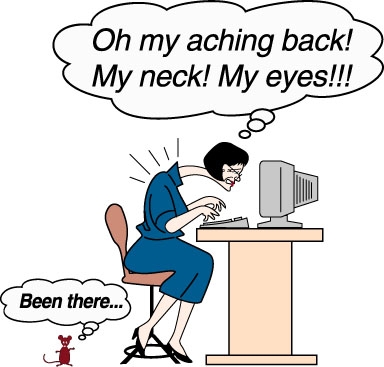
habit? Do you hold your breath when trying to focus? Slump in your computer chair, making full breath practically impossible? Coincidentally, the upper-body breathing is often paired up with abdominal tension. This faulty pattern alone can lead to neck-shoulder tension, gut troubles, unavailable core muscles, pelvic pain, and unstable lumbar spine… The variety of poor breath habits range from chest breathing, to collapsed breathing, to hyperventilation and throat holding,
each with its own physical and psychological symptoms.
Many of us, if not all of us, hold the same tensions and restrictions within our breathing muscles as we do in our posture and our movement. Our lifestyle habits - poor posture, unhealthy movement patterns, chronic stress,
inefficient coping mechanisms – all contribute to a vicious circle situation. Tension is present in the fast shallow breathing when we are anxious or stressed; it is also there when we are exercising or even on a yoga mat, trying to breathe deeper.
Yoga students know that everyday breathing habits have a peculiar way of showing up on the yoga mat. That’s part of the reason why yoga practice can be so effective in healing persistent tension and pain disorders.
Surveys of people who live with persistent pain show that out of all possible pain care interventions - medication, physiotherapy, pilates, exercise and personal training - yoga consistently comes at the top of the list.
What about pain?
Pain brings its own challenges to the way we breathe. Healthy breathing provides a natural massage to the
entire body. This massage is, in itself a pain reliever, signaling the nervous system that all is well. Unfortunately, pain disrupts the healthy breathing: most of us, consciously or subconsciously, tense up and hold the breath in response to pain. This pattern often causes perpetuation of pain, often not from the original sensation, but from our reaction to it and our imagining of what might happen if the pain continues or gets worse. For many Pain Care Yoga students, repairing and
re-patterning the breath is a real game changer. Can it be effective for you?
Try a “Gasp test” to find out:
Exaggerate a gasp pattern of breathing (a kind of breathing you do when someone jumps out at you). If the pain increases it is very likely that
breath retraining will be very helpful in reducing the pain. Register for Pain Care Yoga Intro session to find out more.
Here is one of the Pain Care Yoga principles you might find useful:
Exhale: whenever we anticipate painful stimuli, our natural tendency is to inhale and hold the breath. Exhale instead. Observe what happens.
Body-Mind Constitutions: Vata Dosha
I am curious whether the element discussions have started to shift the way you view your body and the world around you? Ayurveda, after all, is the
study of comparative qualities and interconnectedness. For example, the Air element is considered to be light, changeable, and mobile. Inside or outside of the body, the qualities of this element remain constant across the board. Once we understand this rule of permanence, we can begin to recognize the subtle interplay of this element within and without our bodies. This shift is essential to understanding Doshas, or mind-body characteristics.
In the last newsletter I
promised to take a closer look at body-mind types (doshas), specifically Vata dosha.
I can tell you that Vata Dosha is a combination of the two lightest elements - Space and Air; and that Vata is a principle of movement, responsible for the beating of your heart and circulation, the movement of your thoughts and joints, transmission of the nerve impulses, and the rhythm of peristalsis. I can say that this Dosha is light, cold, changeable and mobile, just like the two
elements it is comprised off; and that imbalance in Vata Dosha often shows up as cold hands and feet, constipation, anxiety or insomnia, chronic pain and sore, cracking joints . I can also mention that cold, dry, windy weather affects people with a predominance of Vata in their constitution, or a Vata imbalance. I can say all of that and you will still have very little idea of what Vata dosha really is. In fact, as I was writing this paragraph I realized that Dosha
conversation is best suited for an in-depth workshop discussion ( let me know if you are interested in such a workshop), not a newsletter topic.
So instead, here are 7 Ayurvedic lifestyle tips to survive seasonal transitions and windy weather with grace and
ease: - Stop or reduce multitasking as much as possible.
- Stick to a routine: wake up, eat, exercise, and go to bed at approximately the same time each day.
- Keep warm; make sure your head (ears and all),
neck, and pelvic area are well insulated.
- Switch to warm, moist, nourishing foods. Eat most of your veggies lightly cooked or juiced. Yup, ditch those bright green salads, unless you are willing to cook the greens.
Here is my current favorite juice formula - it looks and tastes like spring:
1 bunch of celery
1 bunch of kale
1 peeled grapefruit
1 pinkie-sized turmeric root (or 1/2 tsp of dried turmeric)
a large handful of parsley
- Avoid icy drinks.
Drink room temperature or warm water; you can also experiment with some warming teas, like ginger-lemon for example.
- Place a warm mist humidifier in your bedroom.
- Spend a few minutes each day practicing mindfulness or meditation. This doesn’t need to be a lengthy formal practice; even a few minutes of observing your breath (just like we did in the experiment above) will make a difference.
I would love to hear how these simple
suggestions work for you. Which ones were you able to integrate, and which ones fell by the wayside? As I mentioned earlier, Ayurvedic approach is highly individualized; in a private consultation setting we look at multiple factors to create a
lifestyle plan that is uniquely suited to your present circumstances. The broad suggestions I’ve included here are a great place to start; book a private appointment so we can design a diet and lifestyle plan for you. See you on the
mat! |
|
|